Friday, April 27, 2007

IBM's mainframe for virtual worlds

IBM will build mainframes to support virtual worlds.

From 3pointD:

In concert with Brazilian game developer Hoplon, IBM will use the PlayStation3’s ultra-high-powered Cell processor to create a mainframe architecture that will provide the security, scalability and speed that are currently lacking in 3D environments — a lack that is one of the factors keeping them from becoming widely adopted.

While it probably won’t have much impact on the state of virtual worlds right off, IBM’s new infrastructure could make a big difference in the long run, by enabling much greater numbers of concurrent users in next-gen virtual worlds, and by creating more secure possibilities for commerce.

From ITH:

"It's a new era. It's the era of application-specific computing," said Bernard Meyerson, chief technologist of IBM's Systems and Technology Group.

There are already massively multiplayer games that support hundreds of thousands of simultaneous players, but the IBM system will add an unparalleled level of realism to visual interactions, Meyerson said.

From 3pointD:

"I had the chance to talk to David Gelardi, IBM’s vice president of industry solutions, who is heading up the effort.

“I would argue that the world doesn’t yet understand the promise of [virtual world] technology,” Gelardi said. “We see this technology moving into banking and retail and anything where the consumer is involved in a transaction of commerce that they would today do over the Web, online shopping, online banking. The problem is that rendering is kind of weak. We haven’t figured out how to accelerate that yet, and how to marry that to transactions.”

From a press release I can't find but is at the above 3pointd post:

"IBM intends to create an environment that can seamlessly run demanding simulations — such as massive online virtual reality environments, 3D applications for mapping, enterprise resource planning and customer relationship management, 3D virtual stores and meeting rooms, collaboration environments and new types of data repositories. It plans to achieve this goal by parceling the workload between the mainframe and the Cell processor"

From eWeek:

"The way to think about it is just look at the way the Web has evolved over time," Gelardi said. "More banking is done online. More shopping and people's hobbies are online. In that context, the next step is to offer 3-D capabilities, and what we are doing is starting with online gaming and then moving into a Web-based commercial world."

Labels: ,

Thursday, March 29, 2007

IBM's Colin Parris: 3D Web

Again from 3pointD at the Virtual Worlds Conference: Colin Parris, vice president of digital convergence at IBM Research, discusses IBM's vision for virtual worlds.

From the post:

"IBM is already working with clients and partners on applications that provide business value in virtual worlds. This is mainly in three categories:
  1. Commerce
  2. Education
  3. Coordination and Innovation
We can clearly see the beginning of an era in which we transform customers’ experiences across the whole value chain. The optimized improvement of business and government that can be obtained will clearly result in reduced cost.

Customization of commerce and transactions that can be garnered from the understanding and insights gained will result in increased profitability in these transactions. The ability to connect real world and virtual world experiences to reduce complexity and risk will result in reductions in cost, and an increase in effectiveness.

New understanding and insights into complex long standing business problems will support all the other implications and enable new implications that will soon arise."

Labels: ,

Monday, February 26, 2007

IBM, Second Life and your cell phone

The BBC has an interesting article about mobile web 2.0 things. The last blurb is about IBM's efforts to bridge virtual worlds like Second Life with mobile phones.

From the article:

"IBM's master inventor Zygmunt Lozinski explained his vision does not simply involve accessing Second Life from your phone - it involves using your mobile as a bridge between the virtual world and the real world.

"You have a group of people who use virtual environments like Second Life, and they interact within those environments using tools like instant messaging and chat. But what would happen if you could connect people and objects in a virtual world to real world communication networks? To your mobile phone, to phones at home?

In effect, IBM's model removes the need for people to exist within a virtual world.

"If you're travelling you may not always have good enough connectivity to interact with people in a virtual world, even if you need to. People can communicate irrespective of whether they're in the virtual or real worlds," said Mr Lozinski. "

See also the Reuters article about Comverse porting Second Life.

From Reuters:

“People are spending more and more time in virtual worlds,” Daphna Steinmetz, head of Comverse Innovation Labs, told Reuters in an interview on Thursday. “We want to bring closer the first life and the Second Life.”

The software was developed over the last six months, well before the open-sourcing of the Second Life client, and relies on using a separate PC or server as an intermediary. Comverse, which plans to demonstrate the products at the 3GSM conference in Barcelona next week, has also created an application that allows Second Life to run on IPTV platforms."

Labels: , , ,

Wednesday, January 24, 2007

Many Eyes

From O'Reily Radar:

"IBM today announced Many Eyes, a site for sharing and commenting on visualizations. Martin Wattenberg, who developed the original version of the treemap we use for our book market visualizations as well as the awesome baby name voyager, and Fernanda Viegas, who worked with him on the equally awesome history flow visualizations of Wikipedia, are the geniuses behind this project.

I asked Martin and Fernanda how they compared themselves to swivel, and Fernanda replied:
You also asked if we see our site as "Swivel for visualization". That phrase isn't quite accurate (any more than Swivel is "Many Eyes for data" ;-). Both our site and Swivel are examples of a broader phenomenon, which we call "social data analysis," where playful, social exploration of data leads to serious analysis. At the same time the two sites fall on different ends of a spectrum. Swivel seems to have some neat data mining technology that finds correlations automatically. By contrast, we've placed our emphasis on the power of human visual intelligence to find patterns. My guess is that both approaches will be successful because social data analysis is a powerful idea.

Martin added:

In Many Eyes our goal is to "democratize" visualization by offering it as a simple service. We also think that there's something special about visualizations that gets people talking, so we placed a big emphasis in design and technology to let people have conversations around the visualizations."
From the site:

"Many Eyes is a bet on the power of human visual intelligence to find patterns. Our goal is to "democratize" visualization and to enable a new social kind of data analysis. Jump right to our visualizations now, take a tour, or read on for a leisurely explanation of the project.

All of us at the Visual Communication Lab are passionate about the potential of data visualization to spark insight. It is that magical moment we live for: an unwieldy, unyielding data set is transformed into an image on the screen, and suddenly the user can perceive an unexpected pattern. As visualization designers we have witnessed and experienced many of those wondrous sparks. But in recent years, we have become acutely aware that the visualizations and the sparks they generate, take on new value in a social setting. Visualization is a catalyst for discussion and collective insight about data."

Labels: ,

Monday, January 22, 2007

The Second Life Goldmine: Sam Palmisano

CNNMoney gets some money quotes from Sam Palmisano, CEO of IBM.

CNNMoney:

"By early January more than 3,000 IBM employees had acquired their own avatars, and about 300 were routinely conducting company business inside Second Life. "The 3-D Internet may at first appear to be eye candy," Palmisano writes in an e-mail interview, "but don't get hung up on how frivolous some of its initial uses may seem." He calls 3-D realms such as Second Life the "next phase of the Internet's evolution" and says they may have "the same level of impact" as the first Web explosion.

But what's beginning to catch the attention of IBM and other huge corporations is something potentially far more profound than a new online pastime. It's the ability to use Second Life as a platform for a whole new Net - this one in 3-D and even more social than the original - with huge opportunities to sell products and services.

In essence, (Linden Lab's) customers are renting space on the 1,750 servers that store the digital representation of the land. One of the biggest landowners is IBM, which rules over 24 islands. Since Linden revamped its business model to focus on real estate, users and revenues have grown at least 10 percent every month.

Easier said than done, of course. Metaverses will become a very competitive field, says Irving Wladawsky- Berger, vice president for technical strategy at IBM. These are just the earliest days of exploration, and needless to say, the outcome is anything but certain. "Today," says Wladawsky- Berger, "virtual worlds are where video and VCRs were in the early 1980s, or where the Web was in 1993."

Labels: , , ,

Monday, January 08, 2007

Sears in Second Life

Sears launched a virtual presence in Second Life today with the help of IBM. (SLurl)

IBM press release:

"Sears is committed to providing our customers with the best possible shopping experience and to looking for new and exciting ways to present our products and services," said Paul Miller, senior vice president, Direct Commerce, Sears Holdings. "The Sears Virtual Home combines the best of virtual worlds and 3-D environments so customers can experience Sears' products in a way that is closer to real life. Sears.com already provides innovative design functionality and this work with IBM in a virtual world is a logical extension of those initiatives."

"Our goal is to help Sears use these 3-D virtual worlds to transform how people shop, from simple appliance purchases to total kitchen makeovers. Customers would be able to test drive their entire dream kitchen in a 3-D virtual environment before it is actually built, which provides a powerful new tool to drive customer satisfaction and sales," said Sandra Kearney, director of virtual worlds and 3-D Internet, IBM.

Reuters SL desk:

"The operator of Sears and Kmart stores is unveiling “Sears Virtual Home,” a prototype showroom in Second Life, on Monday at the Consumer Electronics Show in Las Vegas.

At the Sears virtual showroom, customers can do such things as change cabinet and countertop colors in a kitchen and organize a garage by customizing storage products.

Hoffman Estates, Illinois-based Sears said it hopes consumers will eventually be able to redesign areas of their own homes from its online showroom by selecting washers, tools and furniture.

The Sears Second Life showroom was built in partnership with IBM, which has also created a virtual consumer electronics showroom with retailer Circuit City."

CNET:

"At the Sears virtual showroom, customers can do such things as change cabinet and countertop colors in a kitchen and organize a garage by customizing storage products.

Sears said it hopes consumers will eventually be able to redesign areas of their own homes from its online showroom by selecting washers, tools and furniture."

3pointD:

"Though the build is still a work in progress, Ultravox Freeman, aka Mike Rowe, a senior project manager on IBM’s digital convergence team said, each of the floors will present different possibilities for taking advantage of a 3D online world like Second Life for showing off Sears products and giving consumers more functionality than they could get from a flat Web page.

“It’s currently one kitchen layout, but ultimately you’ll be able to bring in your own kitchen from Google SketchUp or another application,” Rowe said. “You’ll be able to place Sears products in the kitchen itself, change the countertops and cabinet facings. Ultimately, the entire Sears catalog will be available. We want to allow Sears’s customers to get the feel of what their kitchen is really going to look like, and then walk around in it.”

eightbar:

"The whole concept is one of discovering how to help people preview goods in their environment. We have this in a sort of different way with kitchen design firms who come to your house, measure up and render some shots for you on their laptop. This does not replace that but adds to the concept.

This was also built over the Christmas holidays, as a few other things you will see soon were, by an ever growing band of people."

Micro Persuasion:

"Electronic commerce, for all of its ease and convenience, still doesn't offer the same feeling of browsing a physical store. That's all about to change, however. The gap is narrowing as retailers enter the Second Life virtual world. Get ready for V-tail.

IBM and Sears today revealed that they are bringing the 120 year-old retailer into Second Life virtual world in a big way. The presence will include an area where customers can import their own kitchen and remodel it with Sears products. Sears plans to bring the entire catalog into Second Life. It's unclear if you will be able to buy products in Second Life and have them shipped to you, but you have to imagine that's the plan. However, the CNET/Reuters piece makes it sound like it's about driving foot traffic."

Information Week:

"What we're trying to do is help businesses bridge the virtual and the real worlds to benefit their customers," says Michael Rowe, senior project manager for virtual worlds and 3-D Internet, a group IBM formed last December.

Rowe and his colleagues are working with some two dozen clients. Only Circuit City and Sears have been announced.

IBM is betting that a Second Life-style 3-D interface will become a popular alternative form of navigating both the Internet and corporate networks. It aims to be a major contractor in these virtual worlds. Though Virtual Reality Modeling Language -- a format for 3-D graphics on the Web introduced in the mid-'90s -- never really caught fire, perhaps IBM is on to something."

Labels: , , ,

Wednesday, December 13, 2006

IBM Creates 3DWeb Group

Via 3pointD, CNET is reporting that IBM will create a group in January to handle 3DWeb initiatives. Not really a surprise considering the 3D Web initiative was one of the announced $100M innovation projects for 2007.

From CNET:

"Irving Wladawsky-Berger, vice president of technical strategy and innovation at IBM, led the company's response to earlier technologies that rewrote the rules of the computing industry, such as e-commerce and Linux.

"I have been playing a strong role in helping us start our 3D Internet and virtual-world efforts. We are launching a new EBO in this area in January--that is, an emerging business opportunity--much like we did with Linux and the grid," Wladawsky-Berger said Tuesday. IBM believes the virtual realm has potential for training, conferences and commerce, he said.

IBM employees have a significant presence in Second Life, Wladawsky-Berger said. "I think that there are close to 1,000 people in our Second Life community now active, and perhaps several thousand more that have avatars that are not that active," he said."

Labels: , ,

Thursday, November 16, 2006

IBM's Todd "Turbo" Watson on v-Business

From his bio you can tell that Turbo is a player. "He later led the development of the IBM e-business Web site, and most recently has been responsible for helping drive the strategy and optimization of the IBM Software Group Web presence."

Tuesday, Turbo took some time to write up his thoughts on the recent IBM announcement to invest $10m in a 3D world initiative.

From his post:

"For those of us who have been early advocates inside Big Blue around the notion of "v-business," particularly in Second Life, this is very exciting news, as it clearly indicates our own bullishness about the promise of virtual technologies in business, educational, medical, and other organizations that can benefit from a more visual Web environment.

Just as we did in the early days of e-business and Linux, our goal is to build a community and drive the business opportunities for virtual business, or "v-business."

Having been at an Internet World press conference where IBM's commitment to "e-business" was announced over a decade ago, I'm very excited to see a similar commitment to these emerging virtual worlds, and to see them announced very much in the spirit and energy this new frontier presents to businesses and organizations around the globe."

Labels: , , , , ,

Wednesday, November 15, 2006

eightbar covers the IBM event

eightbar has some information and pictures from the IBM event this week.

From the post:


"The event itself was a ‘townhall’ IBM meeting, held in an IBM location in China, in front of more than 6,000 employees. Sam Palmisano presented in person, but when he started talking about Virtual Worlds and the 3D Internet, he first handed over to Irving (who recently blogged about signing up to Second Life) whose avatar was surrounded by a decent sized bunch of IBMers from across the world.

Labels: , , , ,

Tuesday, November 14, 2006

Sam Palmisano's $100M Bet

The Next Net is reporting that one of the things IBM CEO Sam Pamisano will be talking about at the Second Life event is the winners of the Innovation Jams.

The list:

"He is putting $100 million into the final ten ideas in the hopes that a few may turn into billion-dollar businesses. Here is where he is placing his bets:

Smart Healthcare Payment Systems: Speeding healthcare payments by connecting patients, doctors, and insurance companies through smart cards.

Simplified Business Engines: A suite of Web 2.0 business apps (running on blade servers) for small businesses.

Real-time Translation Services: Seamless speech-to-text-to-speech software that can translate one language to another like a Babble Fish (based on IBM Research's impressive MASTOR technology).

Intelligent Utility Networks: Bringing network management and monitoring to the utility grid.

3D Internet: Build a technology platform for virtual worlds so that businesses can conduct meetings, presentations, focus groups, product demos or run virtual stores in a "standards-based 3D Internet" (sort of like Second Life).

“Digital Me”: Online storage and management for personal digital photos, videos, music, files, identification documents, and health and financial records.

Branchless Banking for the Masses: Sell technology to financial institutions that lets them provide basic banking services to the unbanked in remote parts of India, China, and other fast-growing emerging markets.

Integrated Mass Transit Information System: Back-end systems for connecting and managing real-time data for all of a region’s transit systems, and coordinating among buses, rail, highways, waterways and airlines.

Electronic Health Record System: Create a central repository for health records that accepts data from any provider, integrates with the health payment system (see above), and offers personal healthcare records to consumers and their doctors.

“Big Green” Innovations: A new business unit that will focus on emerging environmental opportunities, such as advanced water modeling (looking for water like today we look for oil), nanotech-based water filtration and efficient solar power systems."

Labels: , , , ,

Monday, November 13, 2006

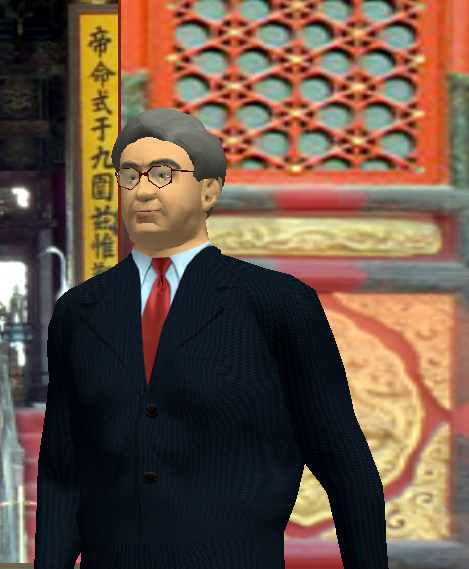
IBM's Irving Wladawsky-Berger gets an Avatar

Irving Wladawsky-Berger, IBM's Vice President of Technical Strategy and Innovation, is "responsible for identifying emerging technologies and marketplace developments that are critical to the future of the IT industry, and then organizing activities in and outside IBM in order to capitalize on them."

Irving recently got his first Second Life avatar. From the post:

"My SL avatar or icon is a fairly realistic representation of what I look like in First Life - again, unlike most inhabitants of Second Life. My IBM colleagues designed my avatar along with the clothes my avatar wears. I have a suit and tie to wear for business meetings. But most of the time I go around Second Life dressed informally in a Pedro Martinez New York Mets baseball shirt, slacks, tennis shoes and a Cuban baseball cap.

My colleagues have built virtual world sites that replicate the IBM Hursley Labs in England and the Almaden Research Center in California. They are building a virtual Beijing Forbidden City.

All in all, this feels to me just like the rise of the Internet and the Web did in the mid-90s. As was the case then, the underlying technologies now being discovered had been in use for a while in the scientific and technical communities – especially among those doing research in supercomputing applications.

We are poised for the next major step. We can now bring these exciting capabilities, already in wide use in science, engineering, defense and consumer applications, into the worlds of business, education, health care and government. This was the step that led to IBM’s e-business strategy ten years ago. Could we be at the onset of v-business? Based on my initial experiences in Second Life, we are all in for an incredible ride. "

Labels: , ,

Second Life Stories: Nov 13th, IBM, Amazon and Sun

So I couldn't keep up with everything last week and need to make sure I have time for everything this week. I may do the "Second Life Stories" as a weekly catch all for things I missed. We'll see.

CNN/Fortune: "No, Second Life is not over hyped"

"Yet Second Life may be more important, longterm, than even this much publicity would suggest. That's because what it really may represent is an alternative vision for how to interact with information and communicate over the Internet.

So far Second Life is way too hard to use. The people who do best there are still techie types. It requires a fairly powerful computer. You have to download a special software application to use it. It can't be used in many corporate offices (like mine at Time Inc., for instance).

But Second Life is important as much for what it represents as for what it concretely offers today. Looking at Second Life makes me realize just how much the Web, wonderful and useful as it is, still mimics a print model.

Second Life goes much further. It took a radical approach to design from the beginning. It offered itself as a mere platform for the creations of its occupants. Essentially everything seen inside the software today was created by its users."

Information Week: "IBM gets a Second Life"

"IBM is set to invest $10 million over the next twelve months to increase its presence in the market for technologies that enable so-called virtual worlds such as Second Life, a 3-D Web environment in which people from various walks doff their everyday identities to assume online alter egos, a company spokesman said Friday.

"Just as AOL and other early Internet services were early entry ways into the largely undeveloped World Wide Web, Second Life, other virtual worlds, and massive, multi-player game environments are the precursor to a 3-D Internet," says the spokesman. IBM wants to create 3-D business environments that mirror Second Life's interactivity and sense of immersion. The company envisions scenarios under which, say, a team of healthcare researchers from around the world could enter a virtual meeting room to tackle a disease outbreak.

Silicon.com: "Big Blue expands into Second Life"

"Chairman and chief executive Sam Palmisano is set to visit Second Life on Tuesday, following a "town hall" meeting with some 7,000 employees in China, and speak with the more than 250 IBM employees on one of the company's virtual islands.

The company is looking to build a private 3D intranet where it will be able to discuss sensitive business information. It is moving to champion what it calls "v-business" - short for virtual business - just as it championed "ebusiness", or electronic business, during the dot-com boom.

Sandy Kearney, IBM's director of emerging 3D internet and virtual business, said: "We always ask the question, 'if you knew 20 years ago what you know about the web today, what would you do differently? The web took decades. This will likely take half that time."

Reuters: "IBM accelerates push into 3D virtual worlds"

"Big Blue has already established the biggest Second Life presence of any Fortune 500 company. It is also looking to build a 3D intranet where its clients will be able to discuss sensitive business information.

The company’s move into virtual worlds is due in large part to the efforts of its “multiverse evangelists,” Ian Hughes (Epredator Potato) and Roo Reynolds (Algernon Spackler in-world), who said last month that IBM wanted to make “v-business” a priority just as it championed “e-business” during the dot-com boom.

“The essence of ecommerce today is built around the idea of catalogs. That’s very useful, it fits with the idea of Web pages and catalog pages, but most people don’t think of shopping in terms of catalogs and pages, but in terms of stores that they go into,” said IBM chief technology strategist Irving Wladawsky-Berger (Second Life name Irving Islander).

“In addition to our desire to work more closely with Linden Labs, we’re exploring how we can work with many virtual world players, including companies like Multiverse and Bigworld Technology, as well as open source platforms like Uni-Verse.org,” the spokesman said in an email. “IBM’s ultimate aim is for inter-world integration, instead of separate islands of virtual worlds, where you cannot cross over from one to the other in a consistent way.”

Second Life Insider: "Quite achievements"

"That's got to be one heck of an island that they've got going on there, I must say. 250 on an island is quite a stretch. 250 on a four-sim corner is still a stretch. Either IBM is getting much better toys, or they're planning to do this in shifts."

Information Week: "Second Life residence build stores around Amazon.com"

This one is important. Bezos is an investor in Linden and SL uses S3.

"Whether Amazon.com becomes a fixture within Second Life will be left up to its members, who build the revenue-sharing virtual stores and write the scripts needed to integrate with Amazon.com's Web services for third-party retailers. Second Life residents do a total of about $6 million worth of business a month, up from about $2 million a few months ago.

"Our strategy is to provide tools that let residents create and enhance their own experience in Second Life, and to let them decide what can be done and how to do it," says Glenn Fisher, director of marketing programs at Linden.

Life2Life (SLurl) is one of the retail projects built around Amazon.com's product services. Second Life residents Tabatha Hegel and Hugo Dalgleish, their names in the online world, are using the search and shopping tools they've created in at least four locations."

Millions of Us: "Sun and open source java Q&A"

"I’m really excited to announce that Sun’s Tim Bray and Simon Phipps alongside Mark Shuttleworth will be hosting a Q&A session in the Second Life Sun Pavilion this coming Monday, November 13th, at 1:00 PM PST. The Q&A session is to follow an announcement that morning by Sun via webcast and other media channels. We will be broadcasting the webcast at the Sun Pavilion to kick off the Q&A session.

A bit more about the hosts, as these guys have really interesting backgrounds: Tim Bray is Sun’s Director of Web Technologies and a co-inventor of XML and Simon Phipps is Sun’s Chief Open Source Officer. Joining them will be Mark Shuttleworth, the Founder of the Ubuntu project (and one of my favorite Linux distributions), and odd tidbit, the version of Linux I used to run (and test) the Second Life Linux Alpha when I worked at Linden."

Labels: , , , , , , ,

Wednesday, November 08, 2006

IBM's Ian Hughes: SLNN Interview

Ian Hughes, of eightbar, is one of IBM's leading Second Life developers.

SLNN:

"SLNN: How does IBM expect to contribute to Second Life's already-enormous potential for business?

Ian Hughes: My main interest has been how to get data in and out of Second Life and integrate with other systems. Given that I work at IBM Hursley (a software development Lab near Winchester, UK) which is home of MQ and CICS, two pieces of middleware that deliver messages across platforms and deal with transactions, it is something that we are able to look at with some knowledge."

Labels: , , , , ,

Tuesday, October 24, 2006

IBM: v-Business

Adam Reuters reports on IBM's continued push into Second Life.

From the article: (photos by Michel Leblanc)

"Computer services giant IBM has plunged into Second Life at the urging of its “metaverse evangelists” Roo Reynolds and Ian Hughes, using it as a location for meetings, training and recruitment. But the company is also eyeing revenue opportunities that could have it vying with Second Life design firms to bring real-world businesses into the virtual realm.

, Ele

“E-business was a strategy for us, why not v-business?” said Reynolds, known in-world as Algernon Spackler, at the “My So-Called Second Life” conference in London on Tuesday. “I don’t mean to be competitive with Rivers Run Red or Electric Sheep, but just like we set up a bricks and mortar business online, we could integrate a company’s services in a virtual world.”

"Integration with services, integration with data — exactly what we helped people do back in the days of e-business, that’s sort of what I envision us doing,” he said. “Mind you, I’m an evangelist, not a strategist, but if I had to guess that’s where we’re going.”

IBM has embraced Second Life to an extent unmatched by any other major company — it has more than 230 employees spending time in-world, and it owns some half-dozen islands. Some are open to the public, but most are private, with restricted access for the public."

See also:
IBM's Secret Island
IBM's R&D in Second Life

Labels: , , , , , , , , ,

Tuesday, October 03, 2006

IBM's Secret Island

Digging a little deeper on the IBM story.

From the Register:

"It would not be the first time the suggestion has been made that games programmers hold at least one key to the future for business systems development. But IBM's latest research project - a "secret island" within the confines of Linden Labs' Second Life massively multi-player games environment - brings that possibility a whole lot closer.

The basic premise is to exploit the multi-player and graphics capabilities at which games programmers now generally excel to create an on-screen virtual analogue of a business.

IBM has decided to use the capabilities already developed by Linden Labs for its Second Life gaming environment to build a separate, experimental area within it. Participants – from IBM research and development departments around the world – can contribute whatever they feel is important to create a productive environment in which to conduct and manage "business".

Communications can be by key-entry text or VoIP if that is appropriate. With text, all the contributions can be easily and fully minuted, and the probability is that speech-to-text systems will allow the same for speech-based interactions in the near future.

The advantage over phone or video conferencing systems is that participants feel they are much more "there" – for example, it is far easier to identify who is communicating what at any one time. It also adds the scope to move away from a formal meeting to relax or "play", or perhaps hold a breakout meeting, all of which can help creativity.

He (Wladawsky-Berger) is also looking at the potential the system might have for furthering the disaggregation of business structures. At one extreme this could lead to their being no "businesses" as we know them today – everyone would be self-employed."

Labels: , , , ,

IBM's R&D in Second Life

Irving Wladawsky-Beger, VP, Technical Strategy and Innovation at the IBM Corporation, has been thinking about Second Life.

From the post:

"Last week I was in London. One of the main reasons for the trip was to meet with members of the press to discuss our new initiatives focused on the impact of massively multiplayer online games (MMOG) on business, in particular those games that are truly best thought of as virtual worlds or virtual environments, like Second Life.

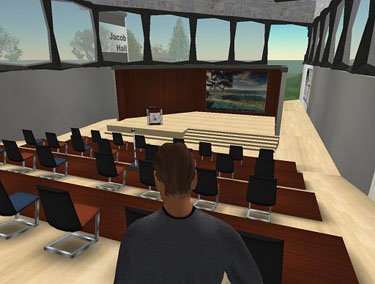
To learn what is required in a practical way, we have been using the Second Life platform to conduct a series of experiments, such as holding virtual meetings on a variety of subjects with groups of various sizes. The meeting participants are represented visually by their individual avatars or personalized icons in the virtual world. We are very interested in understanding how best to conduct such virtual meetings.

eightbar:

"To underline this importance we had Dr Irving Wladawsky-Berger our vice president of technology strategy and innovation at IBM over here in UK from the US. He is a well known figure inside and outside of IBM becuase of his very open attitude to ideas and his smart way of understanding so many areas that IBM works in. He freely admitted that he was put on the track of considering anything related to games technology a few years ago by Hursley’s Chris Sharp.

We put on a show for everyone around having a truly global meeting in Second Life as a backdrop to all our conversations. We had people from India, UK, US, Canada and even Australia, so some people were well into timezone hell.

We illustrated in the actions of the group how we had all taken to the excellant multi gadget chairs by Timeless Prototype. As this lets us indicate we are indeed having a meeting despite the fact that you really dont need to sit down in a virtual world.

To show how we energize brainstorms we used a favourite of Idz Ni’s (and now most of eightbar) of the Abramelin Wolfe canon that lets us fire ourselves about the island. This is the equivalent of taking a 3 min break for chocolate in RL."

Freshtakes:

"IBM’s vice president Dr. Irving Wladawsky-Berger, held a press meet-up in Second Life last week while in London – and in the process brought IBM’s “secret” Second Life island out of the shadows.

The purpose of the press meet-up was to discuss why IBM considers Second Life so important. IBM has been researching and experimenting with virtual worlds to understand, among other things, the importance of visual imagery to convey information - and a vast range of other aspects of human interaction with visual and virtual spaces. IBM believes virtual worlds and gaming will have a huge impact on IT, business, society and our personal lives in the very near future."

Labels: , , ,