Tuesday, January 09, 2007

Cisco's Connected Home

From Linda Zimmer:

"John Chambers, CEO and Chairman of Cisco is scheduled to deliver the keynote address at the Consumer Electronics Show tomorrow. His speech will focus on the “connected home,” which is one of the areas Cisco has targeted as a key growth area in the coming years.

To coincide with the topic and as an element of their consumer strategy, Cisco is also launching The Connected Home in Second Life – and you are invited to a reception there tomorrow, at 4:00 p.m. PST/SLT at Cisco Island.

Cisco and Linksys are also giving away [real] Linksys iPhones in Second Life each day of the CES show which runs today through January 11. (The iPhone integrates web-based multimedia with VoIP services, Skype, Yahoo Messenger and more.)"

Labels: , ,

Tuesday, October 03, 2006

IBM's Secret Island

Digging a little deeper on the IBM story.

From the Register:

"It would not be the first time the suggestion has been made that games programmers hold at least one key to the future for business systems development. But IBM's latest research project - a "secret island" within the confines of Linden Labs' Second Life massively multi-player games environment - brings that possibility a whole lot closer.

The basic premise is to exploit the multi-player and graphics capabilities at which games programmers now generally excel to create an on-screen virtual analogue of a business.

IBM has decided to use the capabilities already developed by Linden Labs for its Second Life gaming environment to build a separate, experimental area within it. Participants – from IBM research and development departments around the world – can contribute whatever they feel is important to create a productive environment in which to conduct and manage "business".

Communications can be by key-entry text or VoIP if that is appropriate. With text, all the contributions can be easily and fully minuted, and the probability is that speech-to-text systems will allow the same for speech-based interactions in the near future.

The advantage over phone or video conferencing systems is that participants feel they are much more "there" – for example, it is far easier to identify who is communicating what at any one time. It also adds the scope to move away from a formal meeting to relax or "play", or perhaps hold a breakout meeting, all of which can help creativity.

He (Wladawsky-Berger) is also looking at the potential the system might have for furthering the disaggregation of business structures. At one extreme this could lead to their being no "businesses" as we know them today – everyone would be self-employed."

Labels: , , , ,

Tuesday, July 11, 2006

Edward W. Felten: Nuts and Bolts of Network Neutrality

Edward W Felton of Princeton provides a great overview of the complexities of Network Neutrality. He breaks it down in 7 section and provides a take away for each one.

From the paper: (PDF)
  1. "This is partly a fight to control innovation on the Internet.
  2. Discrimination has harsher and milder forms. Blocking a packet is harsher than just lowering its priority.
  3. Discrimination hurts some applications more than others. VoIP services are especially vulnerable to discrimination.
  4. Anti-discrimination rules can be hard to write and hard to enforce.
  5. Network discrimination will have unpredictable effects.
  6. Technical countermeasures, such as encryption, cannot fully shield users from discrimination.
  7. Quality of Service (QoS) guarantees are less important than you might think."
Of course if you want to get an idea of why all of this might be hard to regulate, think back several days to the brilliant explanation Senator Ted Stevens gave of the Internet.

Sen. Ted Stevens:

"There's one company now you can sign up and you can get a movie delivered to your house daily by delivery service. Okay. And currently it comes to your house, it gets put in the mail box when you get home and you change your order but you pay for that, right.

But this service isn't going to go through the interent and what you do is you just go to a place on the internet and you order your movie and guess what you can order ten of them delivered to you and the delivery charge is free.

Ten of them streaming across that internet and what happens to your own personal internet?

I just the other day got, an internet was sent by my staff at 10 o'clock in the morning on Friday and I just got it yesterday. Why?

Because it got tangled up with all these things going on the internet commercially."

Labels:

Tuesday, May 09, 2006

Verizon Game Network

Verizon acquired an equity stake in Super Computer International to expand its role in online gaming.
From the press release:

"A primary focus of the Verizon-SCI relationship will be the deployment of a next-generation, online game browsing and messaging platform called PlayLinc that will give gamers more control over their multiplayer gaming interactions, a richer set of social networking tools and a wider variety of gaming experiences. Among the features gamers can take advantage of on the PlayLinc platform will be support for a variety of gaming platforms, messaging tools including IM and VoIP, dynamic server launching, server browsing, team management, buddy tracking, player invitations, on-game controls and more.

"Verizon’s relationship with SCI will help us speed the development and distribution of an advanced online gaming platform with capabilities that we believe no other game messenger currently delivers," said Mitch Dornich, group product manager for new product development at Verizon. "We’re bringing together Verizon’s strengths in broadband, the Internet, communications and mass marketing with SCI’s state-of-the-art gaming technologies and expertise to create an entirely new experience for the online gaming community."

Jesper Jensen, CEO of SCI, said, "We’re excited to be joining forces with Verizon. The platforms we are devising will reset the standards and expectations of online game players while simplifying and accelerating their ability to build highly customizable gaming communities and personalized social networks."

Labels: , ,

Tuesday, May 02, 2006

Telco Reform: No Net Neutrality

Daily Wireless has a follow up to TechDirt and the CNET article.

From the post:

"Telecom reform or not?

Here are some parts of Sen. Ted Stevens' proposal to rewrite U.S. telecommunications laws:

Audio broadcast flag
Devices would be banned based on "consensus" of FCC-created review board, which has a year to do this.

Broadband taxes
Taxes would be imposed on VoIP and broadband providers.

Child pornography
FCC would be asked to come up with rules banning child porn on local video services.

Municipal broadband
Cities and states could set up their own networks, with some restrictions.

Net neutrality
No new powers for FCC; it would publish a report instead.

Video broadcast flag
Some over-the-air receivers likely would be banned within six months, but regulations allow some fair use.

VoIP providers
Companies offering Internet phone services would increasingly be regulated and taxed as traditional phone companies."

Labels: ,

Thursday, April 13, 2006

Gary Forsee, Sprint CEO, Talks to the Cable World

MocoNews has some key points from a pannel at The National that included Sprint CEO, Gary Forsee.

From the post:

"Sprint has been on a two-year path to reposition our company. We’re describing our company, not as a telcom carrier but a content media and entertainment distribution company in the data services business. When we spin off our local business in May, we really will be positioned to be the cable industry’s ideal partner because our company will be positioned both on providing VoIP as well as wireless services."

Labels: ,

Tuesday, April 11, 2006

CableLabs: Faster Access

Also from Daily Wireless, this encouraging news on future access rates:

"CableLabs are now working on the next generation, DOCSIS 3.0 that will blow today's cable modem speeds out of the water. DOCSIS 3.0, could offer downstream bandwidth of 200 Mbps per channel, and 100 Mbps per channel upstream.

The 3.0 version would give operators enough bandwidth to offer a wide range of IP-based, entertainment-quality media services.

DOCSIS roadmap
DOCSIS version
DOCSIS 1.0
DOCSIS 1.1
DOCSIS 2.0
DOCSIS 2.X
DOCSIS 3.0
Services
Broadband Internet
X
X
X
X
X
Tiered services
X
X
X
X
VoIP
X
X
X
X
Video conferencing

X
X
X
Commercial services

X
X
X
Roaming services


X
X
Entertainment video


X
Consumer devices
Cable modem
X
X
X
X
X
VoIP phone (MTA)
X
X
X
X
Residential gateway
X
X
X
X
Video phone

X
X
X
Mobile devices


X
X
IP set-top box


X
Downstream bandwidth
Mbps/channel
40
40
40
40
200
Gbps/node
5
5
5
5
6.3
Upstream bandwidth
Mbps/channel
10
10
30
30
100
Mbps/node
80
80
170
170
450

CableLabs is early into the DOCSIS 3.0 process. The timeframe will depend on how quickly members want to move ahead on it, according to Communications, Engineering and Design Magazine."

Labels: ,

The National Show

Daily Wireless has a big round up of all things cable at the National Show.

From the post:

"Cable's annual convention, The National Show, is rolling out the big guns in Atlanta this week. The battle for the $490-billion-a-year U.S. market for phone, Internet and TV services is heating up. The war between cable, satellite and phone companies is going nuclear, as people disconnect their landline phones in favor of cell phones or VoIP over cable.

US carriers have reportedly lost more than five million telephone customers to cable rivals Time Warner Cable, Comcast and Cox Communications over the last year. More than 1 million customers now use VoIP services developed by Sprint Nextel in tandem with cable companies. Sprint has forecast that some $1 billion will be generated by VoIP services by 2009.

By 2010, 55 percent of U.S. broadband households will subscribe to a triple-play or quadruple-play bundle, Parks Associates predicts. And, revenues from bundled services, most notably the quad-play, are expected to reach nearly $120 billion."

Labels: , , ,

Friday, March 24, 2006

Wireless VoIP Demystified

Martin Sauter has a three part post with some great technical information about VoIP, specifically he talks about UMA, SIP, and IMS.

From the UMA post:

"First on the list is UMA, a 3GPP standard like GSM and UMTS, loved and feared alike by mobile operators (or carriers as you say in the U.S.). The principle of UMA is simple: It replaces the GSM radio technology on the lower protocol layers of the mobile phone with Wireless LAN. A call is then tunneled via a Wifi Access Point connected to a DSL/cable modem via the Internet and a gateway to the Mobile Switching Center (MSC) of a mobile network operator. The gateway between the Internet and the network of the mobile operator is called a UMA Network Controller and one of the companies developing such a network node is Kineto Wireless."

From the SIP post:

"The basic architecture of SIP is simple: A SIP server in the network forms the central element of a VoIP network. VoIP clients are either software clients on PCs or notebooks or standalone devices like phones with an Ethernet port. When connected to an IP network their first task is to register their IP address with the SIP server. To call another device, a SIP client then sends a request to the SIP server. The SIP server then retrieves the IP address of the destination device from its database and contacts the destination device. If the destination device is willing to accept the call, the server informs the originator of the IP address of the destination device and a direct IP connection is established between the two parties."

From the IMS post:

"IMS standardizes a service framework and a protocol between the IMS core and application servers that allows third parties to create new services based on IMS and SIP commands. Such services are for example instant messaging, presence, voice mail, video mail, location based services, short dialing numbers, private dialing plans, music and video streaming, push to talk, etc."

Labels: ,

Thursday, March 23, 2006

IPTV Round Up

As usual Daily Wireless covers all of the recent IPTV developments.

From the post:

"
How big a gamble are phone carriers taking with television? It depends who you ask. American carriers have lost more than 5 million telephone customers to cable rivals Time Warner, Comcast and Cox during the last year as cable firms move into the VoIP marketplace, says America's Network.

Siemens executives said in December the global market for IPTV could hit $1 billion by 2009, with China expected to account for a quarter of the spending.

By the end of 2007, ATT/SBC expects to reach 17 million households with FTTN and nearly 1 million with FTTP. In 2005, SBC said it expected that its total capital expenditures will be at the high end of its 2004 guidance range of $5 billion to $5.5 billion. AT&T, with BellSouth, will have 70 million landline subscribers.

Research firm Parks Associates (above) estimates 70 million users around the world will embrace IPTV by 2010, up from 5 million last year. The IPTV market is expected to grow as much as 25% annually. Infonetics Research says there will be 13 million IPTV users in North America by 2009."

Labels: ,

Wednesday, March 22, 2006

VOIP to Take $35 Billion from Telcos

An article from Telecom Magazine sites a recent Juniper study that can't be good for the RBOCS.

From the article:

"According to a new report from Juniper Research, VoIP revenue from this sector -- worldwide -- is projected to reach an annual US$18 bn by 2010.

Other projections that Juniper throws into the business VoIP mix is that small business broadband connections will reach 40 million lines by 2010 and that hosted VoIP business revenue will reach US$7.6 bn.

Despite this new VoIP revenue stream, telcos will still make a net loss in revenue -- courtesy of VoIP’s arrival -- to the tune of an annual US$36 bn. This loss, presumably, is largely down to the fading away of telcos’ more lucrative leased line revenue, although Juniper does not say so explicitly in its press statement.

“VoIP has the potential to transform business communications in terms of call costs, cost of operations and integration with business processes,” says Barry Butler, report author. “However, as with other IP-based platforms, IP is a disruptive technology which will reshape the business communications service provider community.”

Labels:

Yahoo Voice Launches

Yahoo's voice app launched yesterday.

From Daily Wireless:

"
Yahoo Tuesday launched a PC phone service used in conjunction with its Yahoo! Messenger service. Those signing up can receive unlimited domestic calls for $2.99 a month or $29.90 a year. You can also purchase prepaid voice credit in $10 and $25 increments.

Yahoo will charge 2 cents a minute for domestic calls, on top of the monthly $2.99 fee. Per-minute charges to 180 other countries will vary. It won't charge to receive calls.

Yahoo is undercutting Internet telephone leader Skype by about $1 monthly for such PC-to-phone service."

From TechCrunch:

"Phone Out on Yahoo is a little cheaper than Skype on average (Skype rates, in Euros, are here). Phone In is also cheaper - Skype charges 30 Euros per year for their comparable product. Skype has video calls, of course, and Yahoo doesn’t. Neither company frustratingly, allows for call recording (Gizmo has this feature and I love it).

Yahoo licenses GIPS VoiceEngine Multimedia infrastructure for the back end VOIP technology."

From Om:

"Clearly, the Yahoo has made a strong bid to integrate most of its communications properties into the IM client. I like the fact that you can send emails, make calls, or even send text messages from the same client. These and more such enhancements are the best way for IM services to differentiate from the new, more slick web-based IM aggregators such as Meebo, and still retain unique brand presence."

Labels: ,

Monday, March 13, 2006

OECD WiMAX Report

Om points to an OECD report titled, "The Implications of WiMAX for Competition and Regulation." (PDF)

From the post:

"The report points out that a typical base-station, can handle an area between 3-to-10 kilometers in a non-line of sight environment. Or about 40 Mbit/s per channel, which basically boils down to this: one cell could theoretically allow hundreds of business connections at 1.5 Mbit/s and thousands of residential connections at 256 kbit/s. It is easier to see why I have always believed that this is a long haul technology, which can then work in tandem with WiFi meshes, for local connectivity.

The report also looks at the potential impact of WiMAX on the new GSM/Wi-Fi phones. The biggest concern, apparently is how those who are building the WiMAX networks will treat standalone VoIP providers. Remember Clearwire had given Vonage the heave-ho from its network."

Labels: ,

Wednesday, March 01, 2006

Cable VOIP 2005 Growth

Om points to a number of releases about the growth of cable's VOIP product.

From the post:

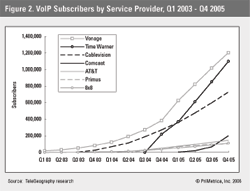
" According to UBS research estimates, there were 5.1 million cable voice users at year end, up 63% annually and 14% sequentially.

Telegeography estimates that nearly 900,000 new subscribers were added in the final three months of 2005, and cable providers now account for nearly 52% of the total market. Their total differs from UBS by about 700,000 subscribers. Telegeography says that there are 4.5 million VoIP subscribers in the US. Phone companies come in with 11% share of the market, and independents like Vonage have 37% of the market."

Labels:

Tuesday, February 21, 2006

Click to Call

A recent survey from Airwide Solutions states that:

"By 2008, 89%of brands will use text and multimedia messaging to reach their audience, with nearly one-third planning to spend in excess of 10% of marketing budgets on the medium. In five years over half of brands(52%) expect to spend between 5% and 25% of total marketing budget on mobile marketing."

Its still hard to tell exactly what mobile marketing is but there is certainly a ton of convergence that will take place over the next five years. First eBay acquired Skype (PDF.) Now Microsoft is getting in the VOIP game.

And then this from The WSJ (subscription required.)

"Consumers trawling Google Inc.'s search engine may have noticed a new icon appearing beside some advertisements on the Google Web site: a little telephone handset.

The handset image is part of a "click to call" test that Google has been running since late last year. Web surfers wanting to talk with a participating advertiser can type their phone numbers in a designated space and have Google connect them on a free call. Google gets the consumer and the merchant talking by causing both their phones to ring at the same time.

"It's the most promising new model in paid search," says Gerry Campbell, vice president of search and directional media at America Online. "Is it as big as paid search? Hopefully, although I don't think that's realistic in the next five years."

Connecting consumers and merchants by telephone could bring new advertisers to paid search, particularly small businesses and services firms that don't transact business online. It could also help companies that rely on call centers to sign up customers."

Labels: , ,

Monday, February 13, 2006

Nokia UMA

Carlo at MobHappy discusses Nokia's push for UMA.

From the post:

"There’s little doubt that UMA will be a disruptive force in the mobile telecom industry. It promises to meld the benefits of fixed or PC-based VoIP with those of mobile telephony. But why it’s so compelling for Nokia is that it gives them an opportunity to expand their pool of customers beyond just mobile operators. Sure, they go on about how mobile operators can leverage all their assets and plenty of other buzzphrases, saying UMA lets them boost network coverage and reduce costs as well as introduce new services. But it also gives plenty of companies that want to get into the mobile space a foothold — companies like cable operators, fixed-line companies, even strong Internet brands.

For someone like a cable operator, an MVNO using its own networks for UMA backhaul is a pretty compelling proposition. A fixed operator can offer a similar network, and for a diversified telecoms company, like France Telecom — say with its Wanadoo ISP and Orange mobile network in the UK — it makes even more sense. The telecoms infrastructure market is slowly melding fixed and mobile; for consumers this mix will happen even more quickly. By seizing on UMA, Nokia can expand outside its traditional networks sales area, and grow its carrier customer base."

Labels: , , ,

Wednesday, February 08, 2006

Detecon's IPTV Study

Lost Remote points to a MediaPost article about a IPTV study released by Detecon.

Lost Remote:

"For IPTV to proliferate, there is a desperate need for increased bandwidth at telecom hubs. Today’s infrastructure couldn’t sustain the delivery of multiple streams of a popular show at the same time. When it comes to TV, people buy entertainment, not technology, so IPTV also needs to come up with unique programming of its own if it is ever to compete with broadcast, cable, and satellite."

MediaPost:

"
In the long run, Pfeffer predicts, as telecoms and cable operators both compete to deliver digital "triple play" (voice, video, and Internet) to every household, if there is no content differentiation, the result will simply be a price war: "In the end, if there is feature parity, the only differentiation will be price."

Detecon press release:

"Dr. Pfeffer also cautioned that most of the current Telco IPTV models are undifferentiated “Me-Too” video offerings aimed at helping Telcos gain mere parity with the Cable MSOs, who are quickly deploying VoIP for Triple Play. “We can help Telcos be more innovative by leveraging their communications leadership, while expanding into entertainment services” added Dr. Pfeffer. “Building an IPTV capable network is certainly within reach for Telcos, but succeeding in the market will require a dramatic culture change.”

Other key findings include:

The Future of Television –Video on Demand?

VoD might be the killer app, but it is not restricted to movies and also includes TV programming recorded with NPVRs (Network Personal Video Recorders). The problem is if VoD becomes a prevalent form of TV viewing (unicast vs. multicast), the current IPTV networks Telcos are building will not have enough bandwidth.

Renewed CAPEX:

The current ADSL network can not support IPTV and must be overhauled, with double the CAPEX needed to future-proof the network. This investment should benefit equipment manufacturers and lead to further concentration in the industry.

Small is Beautiful:

There are many successful deployments of IPTV across the world. Most of them are by small or medium size operators. Large operators are struggling."

Labels: , , ,

Wednesday, December 28, 2005

Om and Niall podcast transcript: Two Tiered Internet

Om and Niall have a transcript up for one of their recent podcasts. They dive into the discussion of the two tiered Internet and what that might mean if it happens. Go read the whole thing because this issue is really important. Highlights to follow:

Niall: "So to give a little bit of a background, the general idea behind the two-tiered Internet is being able to, on the service provider level, select certain services or certain websites to packet prioritize or be able to give better performance to a certain application or degrade performance of another, competing application, for the benefit of your own networks, your own pocketbooks.

Some examples may be to just cut off Skype entirely to keep your own VoIP products alive and running, to drop iTunes Music Store or podcasts from your service to make sure your own music service is alive and well, or it could be someone working out a deal, for example a search engine, where a network operator could prioritize Yahoo! over Google some payments. That's what we're talking about: the ability to use traffic shaping or packet prioritization to build a different tier on the Internet and to control what services flow across the pipe."

Om: "I cannot stress enough that they will not go out of the way to degrade somebody's service. They will go out of the way to upgrade their own service, which are two different things. But the end result is pretty much the same. You know, it's like, "Hey it's my car. If I drive it at a hundred miles an hour, who are you to say anything?" So that would be their argument, but that's a valid argument though."

Om: "The biggest concern right now is, what if we go back to the same argument I made earlier, what if they start shutting down access to IP services, which do not pay them at all? That's wrong."

Labels: ,

Friday, November 04, 2005

Top 10 Global Wireless Predictions for 2006

inCode released this report a few days ago but I just saw it. Here are the highlights they pull:
  • A digital music innovator will launch a Mobile Virtual Network Operator (MVNO) focused on mobile entertainment services
  • Consumers will "“snack"” on mobile TV, which will not be a killer application
  • A new business model for voice services will emerge, based on mobile Voice-over-Internet Protocol (VoIP)
  • At least one major network operator will abandon its retail brand and use wholesale access as an innovative business strategy
  • China will become a telecommunications leader, and Chinese investors may buy a controlling interest in a wireless company

Labels: , , ,