Wednesday, July 25, 2007

NBC: digital local content

NBC's new O&O guy says digital content for local TV stations needs to focus on local. John highlights the need for "local portals" and hopes to have "laser beams" in a bid to become the "Diet Coke" of "local content": just one calorie, not local enough.

From Broadcast & Cable:

"John Wallace, the new president of the NBC owned and operated stations, is urging his general managers to put as much of a local stamp on their product as possible. "You’ll see a big change in the focus on local, in terms of our digital strategy," he says. "It's our intent to have a bigger presence in niche communities and get away from general news."

Wallace stressed the significance of "local portals" on the Web that cover topics such as health, entertainment and sports on an ultra-local level.

"There are a lot of unique qualities in each marketplace," Wallace says. "There’ll be a very different look and feel to how we present content in that marketplace. There’ll be major reliance on [general managers’] local expertise."

Wallace also vowed to make mobile distribution more of a priority. He promised to forge ahead with equal parts caution and ambition: "We’ll move at the right pace, but we’ll take some big swings too."

Labels: , , , ,

Wednesday, July 11, 2007

Tribune's local sites: Metromix

More local websites from traditional media.

From Lost Remote:

"Tribune just took the wraps off LosAngeles.Metromix.com, a “fresh and dynamic new site for young and socially active Angelenos looking for the latest in pop culture, local trends and the newest spots to hit on the scene.” New York is next, and Tribune plans to roll out similar sites across all of its newspaper markets. You may recognize the Metromix brand — it launched in Chicago a decade ago, and Metromix sites already exist in Orlando and Baltimore."

From the press release:

“Our database is deep and current, with nearly 7,000 listings for LA restaurants, bars and clubs, as well as reviews, features, neighborhood guides, trend pieces, blogs and video tours,” said Deborah Vankin. “We have an incredible team of writers-editors who not only know the scene, but are very much of it and will provide true insider coverage — on everything from underground art events to off-the-radar sample sales to how best to get past the ubiquitous velvet rope."

"Metromix is an exciting, new online addition to our portfolio of products, directly engaging younger users and local advertisers in a targeted way," said Robertson Barrett, general manager of latimes.com and vice president of the Los Angeles Times Media Group. "With this launch, we're bringing L.A. an intuitive search engine and great writing by some of the best young talent in town."

Labels: , , ,

Monday, July 09, 2007

Hyperlocal Deadpool: Backfence

Hyperlocal takes a hit with the closing of Backfence. Lot's of people have opinions.

From American Journalism Review:

"The idea of virtual town squares seemed so promising that within months Potts (a veteran reporter and editor at the Washington Post and cofounder of its digital division) and DeFife (founder and chief executive of Womenconnect.com for women in business) had attracted $3 million from two venture capital firms, including one headed by eBay founder Pierre Omidyar.

The money funded an expansion program that would have made Starbucks proud (see "Dotcom Bloom," June/July 2005). By early 2007, Backfence had grown to 13 sites serving towns around Washington, Chicago and the San Francisco Bay area. The partners began talking about creating as many as 160 sites in 16 markets.

And then? And then the bottom dropped out. Backfence's rapid expansion burned up its $3 million war chest. The partners have split; Backfence's staff, which once numbered as many as 25, was laid off. The company's online communities are largely ghost towns now. "We ran out of money," says a somewhat chastened Potts today. "And we ran out of runway."

From Jeff Jarvis:

"I think we need to look at local networks. No one can do it all. Newspapers can’t afford to cover everything. They never could but now they can afford to cover even less. TV and radio stations are covering next to nothing themselves; they have no idea how to get very local. New local ventures, as Backfence proves and Fahri points out, are finding it tough to do it themselves.

Individual bloggers don’t pretend to do it all and need help to get their stuff found and get revenue. And today there just isn’t enough stuff from all these players together to add up to a critical mass of coverage for almost every town and neighborhood in the country. We need more but we don’t yet know how to get it. I believe we can figure this out. But we have to try.

That, to me, is the state of hyperlocal. The work has barely begun.

I think we need a combination of platforms. Everything will not happen in one place; that is why, in my view, both newspaper local sites and independent, stand-alone ventures like Backfence haven’t worked. That is why lone bloggers have trouble making a business of it. They have to work together. They have to become networks that organize, enable, and monetize."

From Lost Remote:

"With 13 sites and $3 million in funding, Backfence is closing down due to two key problems 1) building a loyal user base without breaking the bank and 2) generating significant revenue among small-time advertisers.

Their founder still believes that the keys to success are keeping costs extremely low and bundling multiple sites around common regions.

But few if any sites have really succeeded to date: a study by the J-Lab found that only a handful of the estimated 500 hyperlocal news sites are making money. One of the success stories is Baristanet.com which covers the snazzy New York City suburbs of Montclair and Bloomfield in New Jersey. While the site is getting a ton of buzz, it only generated $60K last year — not enough for the two authors to quit their real jobs."

Bubblegeneration:

"In smaller towns, there just isn't enough supply or demand. Don't believe me? Check out the classifieds listings on most hyperlocal sites - they're updated very infrequently.

Put another way, there are network effects in cities - sometimes called urban economies - which can explode value creation. This is why most young people hate living in the burbs - it's relatively boring.

The numbers bear this out - there's just not enough news/classified/etc volume/reader (population, whatever) to make hyperlocal strategies work.

Now, lots of other stuff does happen in smaller towns - other kinds of interactions, like intense debate over the allocation of public goods, gossip, etc...these are avenues hyperlocal players should be exploring.

But for the typical news model, the deep economics don't - and I suspect can't - work."

From Terry Heaton:

"There are two big problems with most hyperlocal efforts.

One, we get hung up on content when content isn’t the problem. The question is how do you make money in a disintermediated, distributed media paradigm? Experiments in hyperlocal media don’t fail because of content; they fail, because they can’t deliver the promise of sustainable revenue. It is the advertising paradigm that’s the real problem, not how to make more or “hyperlocal” content that such advertising will support.

This is why I keep harping on organizing the local web and building databases of knowledge at the local level rather than trying to make another content play. Google (the hyperlocal winner) has proven that advertisers will pay a premium for actual business leads, but that has never been a part of mass marketing. How we put advertisers together with users is the key, and “news content” isn’t the only way to do that.

Two, in terms of building sites that appeal to “local” people, we simply cannot begin with revenue assumptions. In fact, I would argue that this guarantees business failure right out of the box, because the whole business of local advertising is evolving. How on earth can we create a business plan based on revenue when we don’t know what that revenue play will be? We simply must have the courage to move forward to build audience before we tackle monetizing that audience. If we do this, we’ll build things differently, because we’ll approach the process differently.

I believe strongly that niches are where it’s at downstream and that the long tail is the economic model for tomorrow’s media, so I very much like the “idea” of hyperlocal. But really, folks, Google is the hyperlocal model and their global mission ought to be our local mission — to organize our community’s information and make it universally accessible and useful."

Labels: ,

Tuesday, December 05, 2006

Rapture

Lots of tongues wagging about Rapture, the new social network project from Shawn Fanning.

Mashable:

"Napster founder Shawn Fanning is about to launch another new project in the social networking space: Rupture is a social site for online gamers that has already raised seed money from investors including Joi Ito and Ron Conway."

Business Week:

"Rupture was inspired by Fanning's newfound love of online gaming. During the past year and a half, he's become a big fan of World of Warcraft, joining a guild and climbing up the ranks of players. The more he played, though, the more he became frustrated with how hard it is to communicate with other players, organize game playing together and learn about other gamers' identities, online and offline."

Susan Wu:

"But there’s still market opportunity for someone to provide a cohesive and comprehensive toolset that sits atop the core WoW experience - wrapped up in a UI targeted towards the average user."

Venture Beat:

"Experts say this is a promising area, because millions of gamers have formed communities with each other through playing, but their interactions have been limited by the confines of proprietary software. Why not open up these interactions to the full richness of the Web, let gamers flirt with each other, communicate offline or any number of other things?"

Labels: ,

Tuesday, November 07, 2006

Big Brother in Second Life

Adam Reuters broke the story yesterday that the TV reality show Big Brother is coming to Second Life.
From Adam:

"The popular reality TV show will select 15 Second Life contestants in three time zones. Contestants will have to spend at least 8 hours a day in the transparent virtual Big Brother house for a total of one month, and will complete various tasks such as building replicas of famous buildings. Their fate will be decided by other Second Life residents, who will vote on which contestants will be allowed to stay.

Big Brother Island (SLurl)

From the press release:

"Endemol is the first television producer in the world to establish a branch in Second Life. Managing Director Paul Römer: “The role of online communities is becoming increasingly important. As a producer of cross-media content, Big Brother Second Life represents a fantastic opportunity to amass knowledge of the virtual world. In the future we will use this experience to develop specific content for online communities. Big Brother is the perfect format. Now that it’s been seen by 2 billion viewers all over the world, it is now time to conquer the virtual world.”

Labels: , ,

X-Box Movie Downloads

Paidcontent has a review of the Microsoft announcement on additional X-Box features.

From the press release:


"Beginning Nov. 22, on its first anniversary, Xbox 360 will be the first gaming console in history to provide high-definition TV shows and movies directly to gamers in their living rooms. Xbox 360 gamers will have access to the full-length TV shows as downloads to own and movies to rent via download from the Xbox Live® network, the worldwide leader in online distribution of high-definition gaming and entertainment content.

“We are thrilled to be part of this launch and bring some of our most popular and targeted programming, including Adult Swim’s ‘Robot Chicken’ and ‘NASCAR.COM,’ to this platform direct to gamers via Xbox Live on Xbox 360 as part of their online gaming and entertainment experience. Partnering with Xbox Live represents the ideal environment to extend the relevant Adult Swim and NASCAR.COM brands and reach our fans in the coveted 18–34 demographic.”

- Dennis Quinn, Executive Vice President, Business Development, TBS Inc."

CNN Money:

"The move to digital distribution of video programming is not entirely surprising for Microsoft. The company faces stiff competition this holiday season from Sony (Charts) and Nintendo. Sony's PlayStation 3 is expected to offer a similar service, though this will not be available when the system goes on sale Nov. 17."

NYT:

"Peter Moore, Microsoft’s corporate vice president for interactive entertainment, said the service was initially intended to make the Xbox more versatile and therefore more attractive. “Direct revenue from this over the long term could be important,” Mr. Moore said. “But this is also another reason to buy an Xbox 360.”

PaidContent:

"The Xbox Live Video Marketplace opens for business Nov. 22—the anniversary of the Xbox 360 launch— with content from a variety of companies including Turner Broadcasting, Viacom, Paramount Studios, CBS, Warner Brothers. and Ultimate Fighting Championship This was one of the expected directions for Xbox 360 but, as I wrote earlier this year, the chokehold on supply that kept the core gaming audience from being served initially, effectively postponed outreach beyond gaming. This latest move plays off the already existing Xbox-TV connection. It’s also a one-up area for Microsoft: Xbox 360 owners won’t need Apple’s iTV—unless they’re big Disney fans."

Pixel Trade:

"Pricing has yet to be announced, but I’m told that movie rentals will be competitive with Blockbuster or pay-per-view rates and TV shows will likely match iTunes.

And it really all makes sense. Microsoft will soon launch its music/video player Zune and its console is already capable of streaming aural and visual delights off Media Center PCs. This neatly ties together the various media lines.

This move is the first of its kind in the console realm. Now Microsoft must wait to see how its 4 million users react when the service goes live on the 22nd."

Don Dodge:

"The Xbox 360 launched just one year ago. The combination of Xbox 360, Windows Media Center, and the soon to be released Zune music device puts Microsoft in a great position for home entertainment. Games, music, TV shows, music, photos, and interactive communities all working together on one device and viewable on your TV screen. Oh, and there is more coming. Stay tuned for more Live services. It is going to be tough to keep up with all the announcements coming from Microsoft over the next few months. It just gets better every day."

Labels: , , , ,

Friday, September 29, 2006

Demand Media Raises $100m

That's quite a bit of money. What do they do?

Demand Media:

"We believe that this is the right time to build a different type of new media company," explains Richard Rosenblatt, Demand's chairman and CEO. "The additional capital will allow us to rapidly seize on unique market opportunities in a truly innovative way."

The Demand MediaTM proprietary media platform powers the company's highly-trafficked domains and unique content verticals. The Company leverages cutting edge, user-driven publishing, community and monetization tools in its quest to define the next generation of new media companies."

Leveraging cutting edge, user drive publiching to define the next generation of media companies! That sounds expensive!

"Demand Media's executive team has a vision for the future of new media and a proven track record for delivering on its vision," said Robin Murray, 3i partner. "We are excited to partner with such a dynamic organization that has taken the unique approach of combining domain services, brand-able domains and niche content web sites to form a new media company."

"As traditional media companies are trying to grasp the power of online communities and user-generated content, we see an opportunity for Demand Media to redefine this space," said Fred Harman, managing partner, Oak Investment Partners. "As a Demand Media partner since its inception, we believe this company has what it takes to make the most of the current market environment and we are looking forward to its continued success."

Still not sure... well they aquired Hillclimb Media.

Press Release:

"Demand Media, the next-generation web media company, today announced the acquisition of privately-held Hillclimb Media, which hosts sector-leading sites in travel, sports, and the outdoors, including Trails.com and GolfLink.com. Today's announcement is the latest in a series of online media and technology acquisitions announced by Demand Media as it continues to expand its new media platform. Demand Media's platform supports over 8 million domains and a growing staple of niche content Web sites, including eHow.com."

Ok, buying sites, right...

Press release:

"The newest web media company, Demand Media, Inc., announced from this year's Traffic Domain Conference & Expo its formation by purchasing eNom, eHow and a portfolio of highly trafficked domain names.

"This is a new formula, combining components of the domain industry to form a very compelling platform for the next generation of media companies," explained Rosenblatt. "Direct navigation traffic, combined with specific proprietary content and innovative marketing, will unlock an entirely new realm of Internet media. We look forward to working closely with the domain industry, as we build Demand Media into a global media enterprise."

Um...yeah. All of the sites look like they could have been built with Ning. What kind of burning questions is ehow, that cutting edge, user-driven publishing, community and monetization site, answering today?

How to kiss on a date: "Tips & Warnings - Keep the kissing simple for now. Use a soft touch that will calm your date, especially if this kiss is the first one."

Good job guys - clearly a ton of room for shareholder value to increase.

Labels:

Tuesday, September 19, 2006

MTV's Virtual Worlds

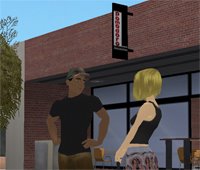
So MTV is building virtual worlds now. I guess Virtual Laguna Beach is based on There's technology but in somekind of private grid. I also guess that the other two offerings will be like that - not sure why you would build walled girds like that but, anyway here are some quotes.

NYT:

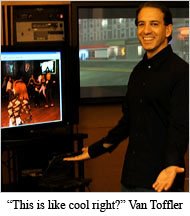
“You can not only watch TV, but now you can actually live it,” Van Toffler, the president of the MTV Networks Music, Film and Logo Group, said in an interview.

One of the appeals of virtual worlds for MTV is the possibility that advertising can spill over into the real one. Visitors might buy a digital outfit for parties using currency they earned watching an infomercial or checking out a new product for an MTV advertiser. Then, they might decide that they would like to buy the same outfit for their offline selves, and, with a few clicks of the mouse and some real dollars, have one shipped to their home. In trial form, Virtual Laguna Beach has advertising relationships with brands including Cingular, Pepsi-Cola, Secret and another Viacom company, Paramount.

To design Virtual Laguna Beach and the other forthcoming 3-D online communities, MTV enlisted Makena Technologies, the creator of There.com. Henry Jenkins, a professor at MIT and the author of “Convergence Culture,” said such virtual communities were a natural next step for mainstream media companies seeking to deepen their connections to fans.

“It’s just layer upon layer of reality and fiction,” Mr. Jenkins said."

PaidContent:

"MTV will introduce Virtual Laguna Beach, an online avatar/role-playing service in which fans of the program can immerse themselves in virtual versions of the show’s familiar seaside hangouts.
This is the first effort. Two other virtual worlds are planned: VMTV is a music destination where visitors can club-hop among hip neighborhoods, buy music, watch videos, sing karaoke or even start their own bands. The third virtual destination, LogoWorld, an offshoot of Logo, the gay and lesbian cable channel, will be designed entirely by its participants.

The only thing: A startup Doppleganger has already launched something very similar to what VMTV sounds like….and has tie ups with AOL’s AIM and Interscope Records. And no mention of that in this NYT story."

3pointD:

"Could this be the beginning of the migration we’ve been pointing to here at 3pointD for some time? That is, the migration from flat online community spaces like MySpace and into their 3D counterparts like Second Life and There.com (which provided the underlying technology for VLB). We of course are betting it is, but it could also mark a shift in how such places get funded and built, from start-up companies that need to seek venture capital to stay afloat, to big media companies getting into the space. The 3pointD age is upon us."

Labels: , , , , ,

Thursday, June 01, 2006

MEX: Defining Community

Via MocoNews at MEX:

"Frederick Ghahramani, director and co-founder of AirG, Vancouver-based mobile social networking specialists. He defined community with four key elements:
  • Identity. How the user is represented.
  • Presence. Tools like IM and ‘online now’ indicators.
  • Interaction. Content sharing, comment functions and so on.
  • The user interface and experience fits round any or all of those.
“Identity gives a reason to interact and presence makes the interactivity real time,” said Ghahramani. Pointing to his own MySpace page, he said: “What I see here is Blogger and Photoshare and then elements of Match.com, only not done as well, Friendster, only not done as well, and Napster - only not done as well. MySpace has become successful by playing a combination game.”

“How do you combine identity, presence and interactivity on a 90×50 pixel screen?.” Embed user interfaces that mimic an online experience are promising. “UI is the most important thing when it comes to mobile comunities. Ultimately it’s going to be UI innovation that will drive market success.”

Labels: , ,

Tuesday, May 09, 2006

Verizon Game Network

Verizon acquired an equity stake in Super Computer International to expand its role in online gaming.
From the press release:

"A primary focus of the Verizon-SCI relationship will be the deployment of a next-generation, online game browsing and messaging platform called PlayLinc that will give gamers more control over their multiplayer gaming interactions, a richer set of social networking tools and a wider variety of gaming experiences. Among the features gamers can take advantage of on the PlayLinc platform will be support for a variety of gaming platforms, messaging tools including IM and VoIP, dynamic server launching, server browsing, team management, buddy tracking, player invitations, on-game controls and more.

"Verizon’s relationship with SCI will help us speed the development and distribution of an advanced online gaming platform with capabilities that we believe no other game messenger currently delivers," said Mitch Dornich, group product manager for new product development at Verizon. "We’re bringing together Verizon’s strengths in broadband, the Internet, communications and mass marketing with SCI’s state-of-the-art gaming technologies and expertise to create an entirely new experience for the online gaming community."

Jesper Jensen, CEO of SCI, said, "We’re excited to be joining forces with Verizon. The platforms we are devising will reset the standards and expectations of online game players while simplifying and accelerating their ability to build highly customizable gaming communities and personalized social networks."

Labels: , ,

Friday, March 31, 2006

1.5Mbps the Same as 6Mbps

This quote from Arstechnica from Randall Stephenson, COO of AT&T, spawned a discussion on Slashdot.

""In the foreseeable future, having a 15 Mbps Internet capability is irrelevant because the backbone doesn't transport at those speeds," he told the conference attendees. Stephenson said that AT&T's field tests have shown "no discernable difference" between AT&T's 1.5 Mbps service and Comcast's 6 Mbps because the problem is not in the last mile but in the backbone.

Go here for the Slashdot thread.

I can promise you there is a difference. I recently moved into a new condo development that touted "bundled services" with "highspeed" interent access. Its a bundle of data, voice, video and security. The billing goes through the HOA.

First, I don't care about security in this situation. I will not be getting a voice solution from a POTS providers. I don't really care about TV.

So what I would do if left to my own devises is get the new 8Mbps data plan from Comcast with the basic digital TV package: one company, one tech support, one bill.

From the Comcast site:

"Or, for $10 more per month (I think that works out to be about $67 per month), you can enjoy the connection of 8Mbps/768Kbps. It's so unbelievably fast, you'll wonder how you ever surfed the Web without it."

Since I can't do that I started asking around about the service. Eventhough its a bundled package you have to deal with each company individually as well and the aggregator companies. The data rate is suppose to be 3Mbps.

Here's what it looks like:
My first call was to Fusion. I asked the nice lady on the phone what the download rates were suppose to be. At the time she thought it might be 1.5Mbps down - they have a number of communities online so she didn't really know exactly. No big deal.

I said, "Wow, that's kind of slow. Comcast is offering a new plan that gives you 8Mbps down."

She said, "But web pages don't download that fast."

Labels: , ,

Tuesday, March 28, 2006

Local Online Advertising

Terry Heaton has a really good overview of the disparity in local vs. national online ad spends.

From the article:

"No one sees this better than Gordon Borrell, whose research and consulting business is based on counting local ad dollars spent online. One service he provides is a precise analysis of the local online ad business, and the volume of dollars being spent usually astounds executives of local media companies, most of whom are getting only a very small slice of the pie.

Borrell poses an important question when he speaks with local media companies. "Will," he asks, "the online advertising pie ever reach the local/national parity that's found with advertising overall?"
One, local media companies simply must move forward with Media 2.0 concepts that offer real value to the communities they serve. This is a difficult proposition, because a.) most existing media companies don't understand the space and b.) they're too busy defending themselves against the disruption to see the value of embracing it.

Two, the local advertising community needs to be brought up to speed on what's possible locally in the 2.0 space, and that doesn't mean spending more on some local media company's portal website.

Three, the VC community needs to see the potential in Borrell's reaching of advertising parity and help fund local online businesses that may or may not be affiliated with public media companies."

Labels: ,

Friday, March 24, 2006

The Value of Online Communities

Gautam Ghosh notices some hiring practices at Google and points to this old but very good article called "The Value of Online Communities," by Shona L. Brown, Andrew Tilton, and Dennis M. Woodside from The McKinsey Quarterly, 2002 Number 1.

From the article:

"What constitutes best on-line practice? According to industry experts and our own analysis, top-performing sites excel in three key areas."

Labels: ,