Tuesday, June 26, 2007

Virtual Goods Summit coverage

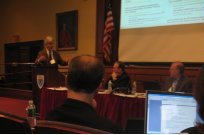
Great coverage of the Virtual Goods Summit by 3pointD.

From 3pointD:

Virtual Goods and Entertainment


"Panelists:

Jim Greer of Kongregate
Erik Bethke of GoPets
Sean Ryan of Meez

Charles: What motivates people to stay engaged, and how do virtual goods play into that?

Ryan: For us it’s about self-expression. When our users spend 4-6 hours online, self-experssion as they show themselves in their IM, in their blogs, in the game, is incredbly impoertant to them. Our most loyal users are female. Unlike in Second Life, where they routinely blow up the American Apparel store, it has to be a conscious choice to engage with the brand. We find our users actually associate with brands. "

The Next Big Business Model

"Panelists:
Tim Stevens of Doppelganger
Kevin Effrusy, general partner with Accel Partners (investor in Facebook)
Dan Kelly, CEO of Sparter
Min Kim of Nexon

Susan: How do you guys estimate the size of the overall virtual goods market?

Dan: It’s easily a billion dollar [secondary] market. Consumers have told us these things have value, the industry now is trying to reconcile that with their business model.

Susan: These are big numbers. Why aren’t more content developers and producers looking at this as a viable business model?

Kevin: If I had a startup doing that kind of revenue on virtual goods, I’d be ecstatic. It’s incredibly high-margin, you have no cost of sales and no sales force associated with it."

Why Virtual Goods Matter

"Panelists:
Craig Sherman of Gaia Online
Daniel James of Three Rings
Amy Jo Kim of Shufflebrain
Byron Reeves of Stanford University and Seriosity

Reeves: The human brian is not specialized to differentiate between virtual and real. Same neurons fire when an avatar smiles at you as when a real person smiles at you. Seriosity is looking at what happens when you create an opportunity to do serious things with virtual currency attached, such as sending email messages with virtual currency attached. The result? You open the email faster when currency is attached. Virtual money changes real behavior."

KartRider

"Min Kim of Nexon gave a presentation at the Virtual Goods Summit and said the company would probably announce the release of its KartRider in the US soon, which has been in closed beta. Kim also said Maple Story has been “kicking ass” in the US, with 3.5 million registered users. The company is also introducing prepaid cards at Target that can be used to buy virtual items, which it expects will push up sales as well. It also just released Audition, which already has 100,000 registered users, more than half of them female."

NeoPets:

"Kyra Reppen of Neopets gave a presentation at the Virtual Goods Summit on MTV’s Neopets. Like other MTV presenters before her, she began her presentation with a video. Perhaps the most interesting part, though, was about the new NC Mall that Neopets will introduce in beta next week.

It’s about customizing and self-expression. It’s complementary to the Neopoints economy, no exchange between the two. Themed items around Neopian events. Launching with PayPal. Why do we think this is going to work? Digital is real life for this audience. Technology is invisible. Emotional connection makes the pixels go away and it’s about these experiences.

Virtual worlds and virtual economies are simply applications to achieve those four core goals: fun, self-expression, social needs, and control. Kids ages 6-14 have $60 billion in income."

Tencent

"David Wallerstein of Tencent began the Virtual Goods Success Stories panel at the Virtual Goods Summit with a presentation, mostly to demonstrate what Tencent is doing in China: Chinese Internet penetration is only 10.5 percent. Wireless is 35.2 percent. Roughly 40 percent of Internet usage in China takes place in Internet cafes. Tencent currently has more than 4,000 employees, with roughly 30 percent R&D staff. Tencent has five leading online platforms:
  • QQ.com is the #1 portal in China
  • QQ games portal is the #1 mini casual games portal in China
  • QQ IM, #1 IM service provider in China
  • They also have a leading wireless portal
  • Qzone, the #1 blog site / MySpace in China"

Labels: , ,

Wednesday, June 20, 2007

Susan' Wu's Virtual Goods Summit

Virtual goods equal real profit.

From Susan's blog:

"Virtual goods and virtual currencies are growing beyond their traditional roots in online gaming and beginning to exert growing influence on the development of social networks, community sites, and casual games. This growing influence is due in large part to the fact that consumers have shown a willingness to embrace virtual goods as a way to express themselves online. From pets to coins to avatars, virtual goods are becoming a real opportunity for companies who are looking to build more engaging online experiences:
  • Neopets users have created over 206 million virtual pets
  • Tencent has over 250 million active users in China and generated $100+ million in Q1 2007, 65% of their revenue comes from virtual goods and services
  • Nexon generated $230 million in 2005, 85% of which came from virtual item sales
  • Habbo Hotel has over 75 million registered avatars in 29 countries, 90% of their $60 million+ yearly revenue comes from virtual goods
  • Gaia Online does over 50,000 person to person auctions a day - making them the 3rd largest auction site on the Internet. Their average user consumes 1200 page views a month.
We encourage you to join us at this year’s event and participate in what promises to be an exciting and lively conversation around some of the key questions facing the virtual goods market today:
  • How will virtual goods and virtual currencies impact social networking?
  • Are virtual goods the next big business model?
  • What does it take to successfully launch a virtual goods offering?
  • Are virtual goods poised to go mainstream?
  • What does it take to nurture and develop a successful virtual economy?
  • Why are users embracing virtual goods?

Labels: , ,

Wednesday, June 13, 2007

Sparter: dollars for gold

Sparter, an virtual currency exchange company, goes live.

From Techcrunch:

"Sparter, a stealth startup founded by Bessemer Venture Partners, launched this evening. They are jumping into the middle of the estimated $1 billion market for buying and selling virtual currencies in games like World of Warcraft (WOW), EverQuest, Eve and others. The current spot price of 100 gold on WOW? About $10.

Sparter acts as the go-between for the parties, keeping payments in escrow until both sides say the virtual transfer went through properly. Users are also asked to rate each other after a transaction. Users with higher reputational ratings may be able to charge a premium.

The company only supports trading in currency for now. Other digital goods cannot be traded on the platform. They say they have no plans to deviate from that strategy, unless users show strong demand down the road."

Labels:

Monday, May 21, 2007

Anshe Chung launches inter-world financial market

Lot's of financial news in the metaverses lately. And now, predictably, here comes a new service by virtual baroness, Anshe Chung.

From 3pointd:

"Virtual entrepreneur Anshe Chung will launch a virtual world-spanning financial market in early June, according to a news release on the Anshe Chung Studios site. The service will “allow direct capital flow and investment across virtual world boundaries,” and will link the markets of Second Life, Entropia Universe and IMVU. Anshe Chung Studios — which is run by German citizens Ailin and Guntram Graef — will provide “a virtual financial market, financial products and a set of services” linking the three worlds.

“We believe that allowing residents in a virtual world, no matter which one they have chosen to live in, to easily diversify their portfolio of virtual investments into other virtual worlds is going to lead to a paradigm shift,” the press release reads. “At ACS we are convinced that once capital is flowing freely, people, goods and services will follow and eventually we will see incentive and pressure for the emergence of open tools and standards. It is our vision that one day even traveling across virtual worlds and taking your belongings with you should become as easy as a mouseclick.”

Labels: , , , ,

Thursday, December 07, 2006

Philip Rosedale on Virtual Economies

From B2.0s December cover story, a few words from Philip on the virtual economy of Second Life:

"I have been in meetings with VCs who said, ‘I cannot buy into the idea that people will pay for virtual items.’ And they are wearing a Movado watch. I ask them, ‘Why did you pay $900 for something you can pay $9?’

The ground rules for creating an online economy is that somebody has got to be able to make money. You need to be able to make money if you want to. If you want to get big you have to be able to turn that money into real currency. We have more than one million residents spending more than $500,000 a day in Second Life. Our GDP and per-capita-GDP is growing at a staggering rate of 200% per month. The exchange rate is 270 Linden Dollars to one U.S. dollar. When you buy currency you are buying it from the market. We literally have to manufacture dollars and sell them into the economy. We inject new money into the economy. We act like the Fed."

Labels: ,

Tuesday, November 14, 2006

Dell in Second Life

TechCrunch doesn't have an update yet but there is this from the Direct2Dell blog.

From the post:

"Just a few minutes ago, Ro Parra, our senior vice president for Dell’s Home and Small Business division hosted a virtual press conference along with Founder and CEO of Linden Labs, Phillip Rosedale to kick off our presence there.

Dell Island consists of a 64-acre area of land that features a welcome area, a Dell factory, a conference facility, a museum and more. Residents will have lots of ways to interact in world with Dell. In the factory, for example, residents can see 3-D interactive views of products, build their own systems in world, and even order real systems from Dell.com.

Initially, we’ll offer the residents the option to order XPS M1710 notebook in world. The XPS 710 gaming desktop that we launched today will be available for order soon. "

Images from Dell/SL:

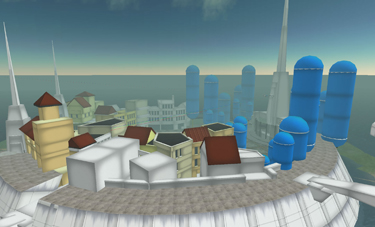
Dell Island

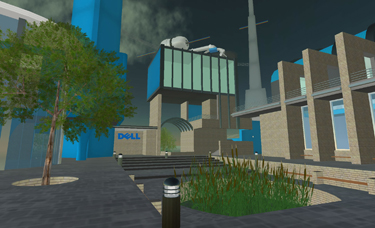
Dell Conference


CNET:

"Second Life residents can use the in-world scripting language to configure their new virtual Dell PCs to perform a number of simple tasks, such as alerting a resident when their friends are nearby, said Rosedale. But for the most part, the virtual PCs are "accessories," he said. "Linden dollars," the in-world currency, will be accepted for virtual PCs but good old-fashioned U.S. dollars are required for a real PC."

Labels: ,

Wednesday, October 18, 2006

Wired's Second Life Travel Guide

Wired's travel guide is online now. It is the most in depth review of Second Life to date. One interesting thing to note, when the article was written the in world population was right at 500,000. As of this morning the total population is now...wait for it...server down. Oh well I will update the real number when the site is back online but I think they broke one million yesterday.

UPDATE: Real number from the site: 983,621

From Wired:

"The vision of former RealNetworks CTO Philip Rosedale, Second Life emerged from beta just three years ago. Rosedale was convinced that the increasing adoption of broadband and powerful processors made it possible to create a 3‑D virtual world similar to the metaverse Neal Stephenson described in his sci-fi novel Snow Crash.

Today, Second Life is second home to half a million people, and everyone from Duran Duran and Wells Fargo Bank to the Department of Homeland Security has funded real estate here. The national currency of Linden dollars is freely convertible to US dollars (and the exchange rate is quite favorable at the moment!), and an increasing number of residents are ditching their jobs back on Earth to make their living entirely within Second Life's economy."

Facts for the Visitor:

"LOCATION
3,000-plus servers at a data center in San Francisco

POPULATION
518,524, growing by 36 percent a month

PERMANENT RESIDENTS
236,562 (Residents who logged in at least once in the last 60

AVERAGE AGE
3.6 months (Skews young due to high birthrate; oldest living resident: 4.5 years)

AVERAGE TIME SPENT IN-WORLD
40 hours per month"

Entertainment:

"SAMURAI ISLAND (Click here to teleport)
Engage in magic-enhanced combat, complete with weapons, acrobatic animations, and gorgeous outfits. Hundreds of players brawl individually or in clans. This game was created by former exotic dancer KatanaBlade Anubis, who makes more money in SL than she did on stage. Buy a sword (around L$800) and start practicing your red flame attack."

Destinations:

"The three main landmasses of Second Life – Heterocera Atoll, the Main Continent, and the Southern Continent – presently cover some 26,000 acres, almost twice the size of Manhattan. They are expanding as fast as new servers come online, and each server adds up to four 16-acre regions. Also growing is the number of private islands – 1,350 as of mid-August – that can be purchased by individuals for development."

Shopping:

"A few tweaks should be enough to keep your getup from shouting “tourist” as you walk down the street. Of course, to really fit in, you’ll need some custom threads – and maybe a new body part or two. Luckily, Second Life has plenty of expert tailors to help you."

Wired in Second Life:

"You will notice that our virtual offices bear a striking resemblance to the innards of a computer. You'll probably wonder whether our brick-and-mortar offices also resemble circuit boards and have gigantic serial ports sticking out the back. In fact, no, our real world habitat is much more quotidian – a cubicle is a cubicle is a cubicle.

But when we commissioned the highly inventive virtual architects at Millions of Us to create the Second Life Wired Offices, we figured, why let Newtonian physics get in our way? As Rodica Buzescu, chief architect on the project, puts it, "The beauty of Second Life is that it allows you to embody an idea in the form of architecture in a way you never could in real life."

Labels: ,

Monday, October 16, 2006

Reuters Second Life News Desk

Reuters steps into Second Life with a news bureau that will report on Sl and RL news.

From CNET:

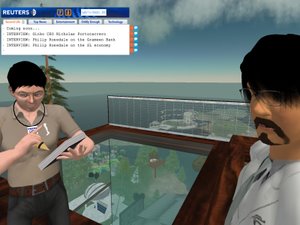
"Starting on Wednesday, Reuters plans to begin publishing text, photo and video news from the outside world for "Second Life" members and news of Second Life for real world readers who visit a Reuters news site at http://secondlife.reuters.com/.

Adam Pasick, a Reuters' media correspondent based in London, will serve as the news organization's first virtual bureau chief, using a personal avatar, or animated character, called "Adam Reuters," in keeping with the game's naming system.

"Second Life" citizens can stay tuned to the latest headlines by using a feature called the Reuters News Center, a mobile device that users can carry inside the virtual environment. Stories will focus on both the fast-growing economy and culture of "Second Life" and also include links to Reuters news feeds from the outside world, ranging from Baghdad to Wall Street."

"As strange as it might seem, it's not that different from being a reporter in the real world," Pasick said. "Once you get used to it--it becomes very much like the job I have been doing for years."

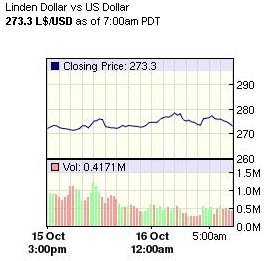
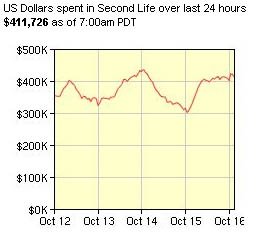
Charts from secondlife.reuters.com


New York Times:

“The fact that it’s in a virtual world doesn’t change things as much as you’d think,” said Mr. Pasick, 30, a Michigan native based in London. “It’s not any different than when Reuters opens up a bureau in a part of the world that has a fast-growing economy that we weren’t in before. The laws of supply and demand hold true, it has a currency exchange, people open businesses and get paid for goods and services.”

(That's Hank Hoodoo in the front)

Eightbar:

"Reuters’ island, created by The Electric Sheep Company, is impressively realistic. Having been heavily influenced by their real-life presence in Times Square (NYC) and Canary Wharf (London), it’s great fun to spot the details from their real-world locations. There’s a news HUD (Heads Up Display)to take away too, which is really worth a play."

Business Communicators of Second Life:

"What is far more significant than the opening of their presence in SL, is that Reuters Second Life News Center signals that Reuters believes Second Life is a viable and "real" business sector – an environment that real business should be monitoring. And, taking the 2D concept of comments from readers into the 3D web, Reuters Atrium is an area for avatars to gather to discuss Second Life stories."

New World Notes:

"Reuters' SL bureau is located on an island dubbed, fittingly enough, Reuters (direct portal here), and it's linked to the heads-up display, which shows Web feeds both from the real world, and from the company's new SL page. "That 'speech bubble' icon [on the HUD] will teleport you to news discussion areas inside the sim," bureau chief Adam Reuters explains. On the island, "[t]here's a big replica of the Reuters display, screens in Times Square, a big video display, and discussion areas for each of the news topics that are on the HUD."

The HUD also displays the L$-to-US$ exchange rate, updated several times an hour. "We'll be doing a lot more with charts and data over the next month or two," he tells me. "Down the road, I'd like to create an inflation index -- pick a basket of goods and monitor the price over time."

3pointD:

"There’s a very nice tower on the Reuters sim, where correspondent Adam Reuters (aka Reuters’ Adam Pasick) will hold regular “office hours,” and you can pick up a free heads-up display or virtual wall-mounted unit that feeds running headlines from both SL and RL that can be clicked through to a Web page for the full stories.

Another nice aspect of the project is that readers can record their interest in a story via the HUD, which will also alert them when discussions on stories of interest are being held and offer them a teleport to the Reuters site if they want to take part."

Labels: , , ,

Wednesday, October 11, 2006

Agencies Marketing to Avatars

Second Life has built up quite a buzz in the past several months.

AdWeek: "Agency Avatars"

"BBH, like Burnett, sees the Second Life investment as a way to enhance the agency experience. "It's a much more exciting way to share work," says Rogers. "You can e-mail a jpeg and take a look at it on your computer and then e-mail your colleague back, but the experience is a bit flat. Here you can look at it and talk about it in real time."

Bottom line, say these agency execs, having space on Second Life is an investment in their futures. "As we move from an ad-centered to an ideas-centered world, my job is to focus the agency on creative and big ideas," Tutssel explains. "It's going to be a great breeding ground for ideas. And our currency exchange is ideas."

Brand Channels: "Virtual Worlds: The Next Realm in Advertising?"

" What do Major League Baseball, Coca-Cola, Wells Fargo, the W Hotel and the American Cancer Society all have in common? They all use a virtual realm to reach out to potential customers and supporters in novel ways. Today, traditional media captures less attention from the younger generation—including the young at heart! New venues that address this demographic are evolving.

What is the real value of advertising in this new virtual world? First, consumers have the ability to experience things not currently possible in the real world. Product trials in virtual settings provide a low-risk environment for testing features and benefits. You can hire avatars to be product ambassadors and answer common questions. Also, you can demonstrate your 3D product or service in use. Live video and jpegs can add to the experience to help educate the user. In some cases, live feeds such as the Atlantis Shuttle launch can be viewed in some virtual settings."

AdAge: "Video Games Now a Social Experience"

"Social-networking sites are grabbing all the headlines about what's new in digital media, but new research from Nielsen Entertainment shows that video games are increasingly being used as a way for consumers to meet and bond with fellow players.

Marketers spent $56 million last year on in-game advertising and product placement, according to research firm Yankee Group. Yankee expects that number, which includes ads placed in both online and console games, to reach $730 million by 2010. "

Labels: , , ,

Tuesday, September 19, 2006

MTV's Virtual Worlds

So MTV is building virtual worlds now. I guess Virtual Laguna Beach is based on There's technology but in somekind of private grid. I also guess that the other two offerings will be like that - not sure why you would build walled girds like that but, anyway here are some quotes.

NYT:

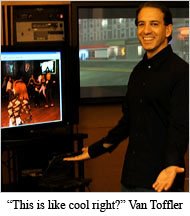
“You can not only watch TV, but now you can actually live it,” Van Toffler, the president of the MTV Networks Music, Film and Logo Group, said in an interview.

One of the appeals of virtual worlds for MTV is the possibility that advertising can spill over into the real one. Visitors might buy a digital outfit for parties using currency they earned watching an infomercial or checking out a new product for an MTV advertiser. Then, they might decide that they would like to buy the same outfit for their offline selves, and, with a few clicks of the mouse and some real dollars, have one shipped to their home. In trial form, Virtual Laguna Beach has advertising relationships with brands including Cingular, Pepsi-Cola, Secret and another Viacom company, Paramount.

To design Virtual Laguna Beach and the other forthcoming 3-D online communities, MTV enlisted Makena Technologies, the creator of There.com. Henry Jenkins, a professor at MIT and the author of “Convergence Culture,” said such virtual communities were a natural next step for mainstream media companies seeking to deepen their connections to fans.

“It’s just layer upon layer of reality and fiction,” Mr. Jenkins said."

PaidContent:

"MTV will introduce Virtual Laguna Beach, an online avatar/role-playing service in which fans of the program can immerse themselves in virtual versions of the show’s familiar seaside hangouts.
This is the first effort. Two other virtual worlds are planned: VMTV is a music destination where visitors can club-hop among hip neighborhoods, buy music, watch videos, sing karaoke or even start their own bands. The third virtual destination, LogoWorld, an offshoot of Logo, the gay and lesbian cable channel, will be designed entirely by its participants.

The only thing: A startup Doppleganger has already launched something very similar to what VMTV sounds like….and has tie ups with AOL’s AIM and Interscope Records. And no mention of that in this NYT story."

3pointD:

"Could this be the beginning of the migration we’ve been pointing to here at 3pointD for some time? That is, the migration from flat online community spaces like MySpace and into their 3D counterparts like Second Life and There.com (which provided the underlying technology for VLB). We of course are betting it is, but it could also mark a shift in how such places get funded and built, from start-up companies that need to seek venture capital to stay afloat, to big media companies getting into the space. The 3pointD age is upon us."

Labels: , , , , ,

Monday, June 26, 2006

Amazonians in Second Life

3pointD.com reports from SuperNova on a comment made by Werner Vogels of Amazon.

From the post:

“There is a group of Amazonians in Second Life,” Vogels said, “and we are building a bridge between Amazon Web services and Second Life so you can go into Second Life and actually try things on there and buy them. There are people who want to use Amazon as a platform to buy and sell things in Second Life.”

[Update:] Vogels, who is VP of worldwide architecture and chief technology officer at Amazon, tells me that there is indeed an “Amazonians” group in SL composed of Amazon employees, and that they are trying to see what it would take to create a Web-services bridge between the virtual world and the shopping site. The effort is not being done under the auspices of the company, he says.

“If we are truly a platform, we should be able to do this,” he said. “These kinds of extreme uses can teach you a lot about your platform.” Vogels admits that SL’s Web hooks may not currently be the perfect tools to support such a bridge, but he predicts success within six months or so.

From B2Day:

People already buy things in Second Life to use within the game, mostly as a form of self-expression. What would really flip my wig, though, is if some of the far-out clothing and objects designed for Second Life were actually fabricated in the real world.


And then there is always the idea of Second Life credit cards, where you'd get a real Visa card that earns loyalty points redeemable for currency in the virtual world."

See also:
Credit Cards for both Worlds

Labels: ,

Monday, June 12, 2006

10 Truths About the Digital Ecosystem

Geoffrey Moore has a list of ten big trends in the digital ecosystem.

A couple of highlights from the post:

"6. Games tell all. Anthropologists of future centuries can be spared digging through layers of sedimentary rock. Instead they will just need to find game machines that let them play World of Warcraft or play back the history of an avatar in Second Life. All the metaphors of contemporary culture are being acted out in one or another corner of this virtual universe. And currency exchanges are beginning to link this universe to the physical one.

The emphasis on symbolic interactions in a digital lifestyle will have unpredictable effects on self-perception and social norms. Historically the real world has set the norms and the digital world reflected them, but the obverse can be expected to be true going forward. Games can become living laboratories to explore strategies for living, a role played by literature and drama in ages past.

4. Everything is media. While advertising will not pay for everything, everything will become a potential opportunity to advertise. This means that at least some technology adoption life cycles can be short-circuited by providing the disruptive innovation for free.

If advertising is the default funder of digital offers, then consumption is the ultimate paradigm. Over time people and cultures will weary of this, and socially constructed content will become more pervasive as an escape from constantly being pitched."

Labels: , ,

Tuesday, May 16, 2006

Harvard Virtual Worlds

The Berkman Island is a project in Second Life.

From the beyond broadcast blog:

"In an attempt to explore novel ways of broadcasting information over the Internet, we are experimenting with Second Life, a 3D multi-user platform.

Second Life has demonstrated great potential as medium for presenting data in audio and video streams to an inworld audience throughout the world. Notable meetings that have aired live events include State of Play and the Game Developers Conference.

Our virtual location within the Second Life world, Berkman Island, is the product of a fruitful collaboration with Second Life citizens. Members of the community have helped landscape, enrich, and create unique content. For the purpose of this conference, we have built an inworld broadcasting center and a 3D replica of the Ames Courtroom at the Harvard Law School."

You can also send post cards of Second Life Berkman events.

An overview of the event in Second Life:

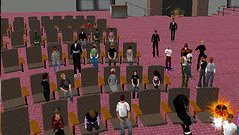
"Throughout the day, we have gotten fleeting glimpses of a replica of Beyond Broadcast — a virtual Ames Courtroom filled with virtual people. This replica conference is taking place in Second Life; a world where every character is controlled by a real person. All objects, buildings, trees, cars and light poles are also created by users.

John Lester, working for the creators of Second Life, Linden Lab, explained the founding principle behind Second Life. John says, “We [at Linden] don’t want to make content, we want to give people tools to make their dreams and shape their world.”

Every resident, Linden’s term for user, has a powerful 3d modeling kit and scripting language, which enables them to build their fantasy. Lester further describes Second Life as a, “Waking dream environment — not completely surreal or mundane, but smack dab in the middle.”

He illustrates this point with a slide of a concert taking place inside Second Life. The musicians are streaming their live (real world) music into a virtual club; the band member’s avatars play their instruments to a virtual crowd. John points out that there is something cohesive about a bunch of people hanging out in a club listening to music, but, he says, you realize something is up when a member of the crowd seamlessly hovers into the air.

Second Life is set apart from most online games and simulations, in that residents retain intellectual property rights to all their virtual creations. Some residents release their creations as open source, while others retain their rights and make money off their work. Residents earn L$ (Linden dollars), which can be converted to $US on Second Life’s currency exchange. The exchange works just like a real market, where residents post offers to buy and sell money. Residents can even resell their Second Life creations back into the real world.

The most entertaining portion of John’s presentation unfolded behind him, on the projector screen, as he spoke; it was the virtual conference watching the real conference talk about the virtual conference. More than 25 avatars were chatting, watching, sitting, standing and floating in the virtual version of Ames. "

Labels: , ,

Friday, April 07, 2006

Credit Cards for Both Worlds

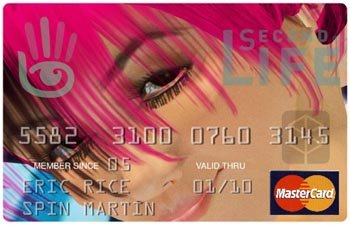
Phillip Torrone, aka Torrone Trumbo, has a post up about credit cards for the real world as well as for in game characters. Here is Joi Ito's card:

From the post:

"Very soon, credit card companies and game makers will reward their customers who spend money in the real world using private label "rewards" credit cards. They will use gifts of virtual currency such as Blizzard's World of Warcraft gold and Second Life's Linden dollars.

As the time of this writing, there are 166,922 residents, spending over 135,984.00 in 24 hours and $6.5 million USD in transactions took place is about 20 days. In 2006, there's a good chance $100 million USD dollars worth of transactions will flow through the virtual world of Second Life. Linden recently rolled out their own exchange, Lindex, meaning - they're almost a bank now.

References and articles:

Labels: ,

Friday, March 31, 2006

CyWorld US

Via Mashable, CyWorld launches a US site. More like Habbo Hotel than MySpace or Facebook, CyWorld is a bid deal in Korea.

From the CyWorld US site:

"Cyworld is a FREE online community that brings people together like never before. Family, coworkers, schoolmates, and best buds are all here -- playing, working and just hanging out.

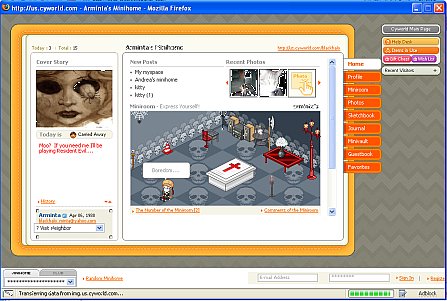
Our Minihome service is a fun way to express yourself while keeping in touch with your friends (and making new ones!) Post pictures, keep a journal and lots more… in style. Join one of our clubs (or start your own) to meet other people who share your interests. Whether you’re into cars, crafts or calculus, there’s a conversation happening right now."

From the post:

Having used the Korean version of Cyworld in the past, I can attest that it’s a fascinating place. In essence, it’s a closed social network with some blog-like features and its own internal economy.

Each user has a “mini-hompy” - a pixelled room that can be decorated with furniture, wallpaper and other items. All these items must be paid for in Cyworld’s virtual currency, dotori (Korean for “acorn”).

If I remember correctly, users can buy virtual currency using their cellphones, or purchase vouchers in real-world shops. Users can also buy each other gifts. There is a huge amount of pressure to be popular and have the best hompy. Unsurprisingly, this has turned Cyworld into an enviable money-making machine - in September 2005, BusinessWeek reported that the company was making “$12.5 million on sales of $110.4 million”. It’s a high stakes game.

Well, I get the sense that the demographic will be much younger than that of MySpace, perhaps more of a rival to Habbo Hotel, the popular pixelated pre-teen hangout. And while MySpace allows you to integrate external services into your page, Cyworld is a closed platform that charges for most additional items. Clearly, this is a very different model to most US social networks, and seemingly at odds with the openness proposed by Web 2.0 and new media advocates."

Labels: , , , ,

Monday, November 21, 2005

Two Gaming articles from Fortune

From Megs to Riches: A general review of virtual property and real dollars paid for it. "Estimates of the size of the nascent market in virtual property range widely, from about $200 million to $1 billion worldwide, —but most industry observers agree that it is increasing at a breakneck pace, possibly 100% year over year."

Yield of Dreams: Brock Pierce, founder of IGE. "
IGE allows players to sell game assets they accumulate in their imaginary worlds —from currency to characters —for cash or, alternatively, to buy virtual assets they would otherwise have to spend dozens of hours earning in a game. Pierce, 25, estimates that IGE accounts for about 50% of this "secondary market" in the U.S., which he says has about $500 million in annual volume."

I have been interested in virtual worlds for a long time. I saw Timothy Leary and Eric Gullichsen, founder of Sense8, in 1988 in San Francisco. They were mainly showing a Air Force Black Hawk simulation that would look like old Sega game today, but was pretty damn impressive back then. ( I bought the second issue of Mondo 2000 from R.U Sirius before going into the conference.)

I played my first multi-player online game dialing into a friends computer (before the internet was an option) to watch his Doom character run down the hall in front of me and fire into a room. I almost fell out of my chair. The image was about the size of a postage stamp.

So, yeah, we've come a long way. I get the feeling its still real early too.

Labels: