Wednesday, October 10, 2007

AT&T buys Aloha's 700MHz

Tired of waiting for the auction, AT&T buys Aloha's spectrum.

From The Street:

"AT&T got a jump on next year's radio wave auction with a $2.5 billion bid for Aloha Partners' 700-megahertz spectrum licenses. In the deal, AT&T would take ownership of former UHF channels 54 and 59, the so-called C block of wireless spectrum Aloha had acquired in the past few years. Aloha owned the largest swath of licenses covering about 80% of the population in the top 100 cities.

From the press release:

"Customer demand for mobile services, including voice, data and video, is continually increasing," said Forrest Miller, group president-corporate strategy and development. "Aloha's spectrum will enable AT&T to efficiently meet this growing demand and help our customers stay connected to their worlds."

From Unstrung:

"AT&T's experience on deploying UMTS at 850 MHz makes 700 MHz a great fit with its existing network," says Gabriel Brown. "In particular, the carrier should be able to source attractive 3G handsets that work at both frequencies."

Brown says the price AT&T has paid for this spectrum is "full but fair." He calculates that, at a price of $2.5 billion for 12 MHz of spectrum covering 196 million people, AT&T has paid roughly $1 per MHz per head."

Labels: , ,

Wednesday, August 01, 2007

22 megahertz of "open access"

Well we were waiting all day for the news but it came over the wires around 6 last night. The FCC approved "open access" for part of the spectrum. Some say its kind of a win for Google but AT&T is keeping its own spin positive.

From Reuters:

"The U.S. Federal Communications Commission on Tuesday voted to shake up the wireless market by approving a set of ground-rules for a big airwaves auction that would require the winner to make them accessible to any cell phone, device or application.

The access requirement would apply to 22 megahertz of the 62 MHz of spectrum to be sold. The FCC suggested a $4.6 billion minimum price for the 22 MHz block of airwaves. If that price is not reached, the airwaves would be auctioned again, but without the access requirement, according to the agency."

Kevin Martin's statement (via MocoNews)

Chairman Kevin Martin: I am committed to ensuring that the fruits of wireless innovation swiftly pass into the hand of consumers.

Currently, American consumers are too often asked to throw away their old phones and buy new ones if they want to switch cell phone carriers. And when they buy that new phone, it is the wireless provider, not the consumer, who chooses what applications the consumer will be allowed to use on that new handset…

A network that is more open to devices and applications can help foster innovation on the edges of the network...We will ensure these open platform rules are implemented, through significant enforcement mechanisms that place the burden on the licensee to demonstrate their compliance and that their policies are fair and reasonable.

Interested parties respond (via GigaOM)

Google: “The FCC took real but incomplete progress this afternoon,” said Rick Whitt, Google’s lead policy exec, in a conference call Tuesday afternoon, lauding the openness conditions but lamenting the omission of rules enforcing wholesale access to the spectrum. When asked if Google would still bid on the spectrum, Whitt said Google “didn’t say it wouldn’t,” meaning that Google will make that decision at a later date.

Frontline: “The FCC [vote] did not make it impossible for us, but they did make it clear that they weren’t going to use [the auction rules] to alter the importance of Verizon and AT&T,” Hundt said. Hundt’s take is that since the rules do allow for a bidder to construct a private-public partnership for public-safety buildout, there is still a chance for ideas like Frontline’s to succeed, but only if tech companies who agree with its goals stop “acting like warring Scottish clans” and instead band together more closely in their efforts.

AT&T: Though we have not yet seen the details of today’s decision on the 700 MHz spectrum auction, the FCC appears to have struck a reasonable balance between the competing interests debating the Google Plan. As we’ve previously noted, if Google is serious about introducing a competing business model into the wireless industry, Chairman Martin’s compromise plan allows them to bid in the auction, win the spectrum, and then implement every one of the conditions they seek. We commend the FCC for adopting this approach rather than stacking the deck in Google’s favor.

Labels: , , , ,

Monday, July 23, 2007

700MHz Shootout: AT&T vs. Google

Things are still heating up in the 700MHZ wars. You probably had a hard time getting through the weekend wondering what AT&T would say about Schmidt's letter.

From Techcrunch:

"CEO Eric Schmidt sent a letter to FCC Chairman Kevin Martin stating that they would commit to bid at least $4.6 billion in the auctions if four key platform rules are adopted. These rules will define what types of services the winner could offer, and would require third party access to the bandwidth:
  1. Open applications: Consumers should be able to download and utilize any software applications, content, or services they desire;
  2. Open devices: Consumers should be able to utilize a handheld communications device with whatever wireless network they prefer;
  3. Open services: Third parties (resellers) should be able to acquire wireless services from a 700 MHz licensee on a wholesale basis, based on reasonably nondiscriminatory commercial terms; and
  4. Open networks: Third parties (like internet service providers) should be able to interconnect at any technically feasible point in a 700 MHz licensee’s wireless network.
From GigaOM:

"Jim Cicconi, AT&T Senior Executive Vice President, External and Legislative Affairs in a written statement emailed to us said:

Not satisfied with a compromise proposal from Chairman Martin that meets most of its conditions, Google has now delivered an all or nothing ultimatum to the U.S. Government, insisting that every single one of their conditions “must” be met or they will not participate in the spectrum auction. Google is demanding the Government stack the deck in its favor, limit competing bids, and effectively force wireless carriers to alter their business models to Google’s liking. We would repeat that Google should put up or shut up— they can bid and enter the wireless market with any business model they prefer, then let consumers decide which model they like best."

Industry opinions:

TechCrunch: "The FCC has competing goals of maximizing revenue from the auction (suggesting less regulation) and protecting the public (suggesting more rules to force competition). Having open access requirements like those suggested by Google will spur competition and grow an economy around this spectrum. It will also put commercial pressure on mobile operators and broadband companies to reduce the restrictions they have on current broadband and mobile services.

GigaOM: "While the sheer historical inertia of the telcos’ lobbying influence may win them the first round of the 700 MHz fight, Google is quickly catching on to the lobbying game, even holding mashup-type camp sessions to show legislators how to join the Internet age. With his letter to the FCC, Schmidt has moved the 700 MHz argument past the “regulation will limit the incentive to invest in new networks” bromide and is instead asking out loud whether the U.S. wants networks that are old and busted, or the new hotness."

Terry Heaton: "As the leader in the open internet world, Google stands to benefit in a purely open wireless world, but so will we all. Big or small, a level field of play will mean an explosion of creativity and applications that we can’t even imagine today. Just look at what has taken place in the 802.11 spectrum (Wi-Fi) since the FCC made that truly open. From your cordless phone to your home wireless network to hotspots in various public and private locations, all are there using “free” spectrum. "

Labels: , , ,

Wednesday, March 28, 2007

AT&T mobile payment and NFC

AT&T is planning to offer mobile payment solutions by the end of the year.

From RCR Wireless:

"AT&T Inc.’s wireless unit is busily exploring and trialing mobile payment systems, and expects to announce a mobile payments system later this year, according to Spencer White, director of mobile financial services and business development for the company.

“This is an emerging segment that we think very highly of,” White told an audience attending the Mobile Payments World seminar at CTIA Wireless 2007.

Some of the factors that have converged to make the nascent mobile payment business attractive, White said, are the replacement of cash by electronic funds sources, the availability of near-field communication technology, the elevation of data services to the mainstream and consumers’ increasingly common use of Internet banking services.

One of AT&T’s trials included a closed environment at Philips Arena in Atlanta, where people were loaned mobile devices preloaded with funds and could order concessions and access content on-site.

“It’s a natural extension of what people are doing online,” he said."

From MocoNews:

"One interesting point is that White said AT&T doesn’t want to offer mobile payments for goods that will go onto the mobile phone bill. “Our customers are price-sensitive, and we have to compete in a very fierce market to keep costs as low as possible...We think there is significant risk in sticker shock,” he said. He’s got a point—it would only be a matter of time before stories came out about people buying whitegoods and getting surprised by bills of more than $1,000."

Labels: , ,

Tuesday, February 13, 2007

AT&T picks MediaFLO

I expect all things mobile are going to come back into the spot light this year. AT&T with its newly acquired BellSouth/Cingular will probably lead the way.

From the press release:

"MediaFLO USA Inc., a wholly owned subsidiary of QUALCOMM Incorporated, and Cingular, the new wireless unit of AT&T, today announced they signed a definitive agreement to deliver mobile entertainment and information services to the wireless unit's subscribers. The two companiesexpect to make the service available to customers in late 2007.

"Our relationship with AT&T will redefine expectations of mobile media for millions of wireless subscribers," said Gina Lombardi, president of MediaFLO USA. "MediaFLO USA is looking forward to delighting those customers with familiar, high-quality content in a compelling, intuitive, mobile media environment."

"MediaFLO USA's service will add another dimension to our robust offering by delivering a TV-quality mobile media experience that perfectly complements our existing voice and multimedia services," said Marc Lefar, chief marketing officer for AT&T's wireless unit. "We look forward to bringing our subscribers a compelling, differentiated service and the innovative devices for which AT&T is known."

"We share with AT&T an exciting vision of a world in which consumers have access to a high-quality mobile media experience wherever they are, whenever they want it," said Dr. Paul E. Jacobs, chief executive officer of QUALCOMM. "This agreement -- the first of its kind between our two businesses -- goes a long way toward making that vision a reality."

From MediaFLO:

"MediaFLO USA delivers the best in mobile multimedia – a true TV experience on a mobile phone. That translates to unparalleled value not only for consumers, but also for wireless carriers, content providers, advertisers and OEMs. When it comes to this mobile-TV value chain, MediaFLO USA runs the entire operation, providing benefits for all service partners.

MediaFLO USA is revolutionizing the TV experience, combining what people know and love about TV with the energy and excitement of new media. Industry stats show the market potential:
  • U.S. mobile TV subscriptions will top 30 million in 2011 (ABI Research, June 2006)

  • U.S. mobile TV subscription revenue will top $2 billion in 2010 (In-Stat, June 2006)

  • In the U.S., mobile TV is more desired than any other cell phone feature (MediaFLO USA consumer research, 2006)"

Labels: , , ,

Wednesday, June 21, 2006

AT&T: Your world. Delivered

So when AT&T begins to offer its cable like video services all of you personal information and usage will be monitored and "delivered" to the government or whoever else AT&T wants to give (sell) it to.

From the article:

"AT&T has issued an updated privacy policy that takes effect Friday. The changes are significant because they appear to give the telecom giant more latitude when it comes to sharing customers' personal data with government officials.

The new policy says that AT&T -- not customers -- owns customers' confidential info and can use it "to protect its legitimate business interests, safeguard others, or respond to legal process."

The policy also indicates that AT&T will track the viewing habits of customers of its new video service -- something that cable and satellite providers are prohibited from doing.

Moreover, AT&T (formerly known as SBC) is requiring customers to agree to its updated privacy policy as a condition for service -- a new move that legal experts say will reduce customers' recourse for any future data sharing with government authorities or others.

In a section on "usage information," the privacy policy says AT&T will collect "information about viewing, game, recording and other navigation choices that you and those in your household make when using Homezone or AT&T U-verse TV Services."

The Cable Communications Policy Act of 1984 stipulates that cable and satellite companies can't collect or disclose information about customers' viewing habits."

Labels: , ,

Monday, June 19, 2006

Response to American Apparel in Second Life

There are a number of posts and articles talking about the launch of the American Apparel store in Second Life.

Forbes:

“Part of the fun of the game is creating characters to look like a model of yourself or to become something fantastic, like monsters or robots or pixies,” says Raz Schionning, American Apparel’s Web director. “People like us for what we stand for, so they’ll have the chance to dress their characters in our clothes.”

CNet:

"The action was initiated when someone from American Apparel approached popular 'SL' architect Aimee Weber about opening a virtual version of the clothes store, according to Wallace.

Weber, who designed the building, said it was based on the fashion label's Tokyo showroom, Wallace reported. The sleek, mostly glass structure is shaped like two stacked boxes, and features lighting that changes at virtual nightfall.

The retailer's use of eye-catching colors and revealing cuts, though conservative in comparison with the racy, barely there styles sported by 'SL' avatars, reports Wallace, fit with SL's culture, which revolves around the pursuit of sex and fashion."

Clickable Culture:

"Unlike a handful of recent big-business appearances in Second Life, American Apparel seems to be taking a sensible, integrated approach to creating a lasting brand experience. Fashion is possibly the biggest industry in Second Life (aside from the sex industry)--surely official American Apparel merchandise will sell well in the virtual world, possibly resulting in real-world sales, too. It's conceivable that the company could also offer new clothing exclusively in Second Life, or even use the virtual world as a place to test new clothing lines."

In-Game Advertising:

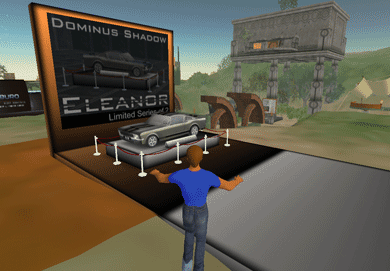
"Blurred borders: the AA's Fine Jersey T dress on the web, pictured on the display (modelled both in real life and in SL), on the racks and on customer. When you touch the display, a dialog pops up inviting you to check the corresponding webpage. The real life dress costs US $26, the Second Life version costs 350 in Linden playmoney, or about $1."

On trade marks in SL, Jerry Pepper (found on Socbleizer):

"But, why is it so important that I had to wait to write about SL trademarks and American Apparel? Because they all tie in together. If corporations are going to begin launching officially branded SL products in the game, if there are already trademark infringements, that is going to impede companies from going in to the SL universe. The demographics for SL are quite interesting - the right age, the right breakdown of males/females, a good number of real-world transactions - that many companies are going to look at SL as a new place to market."

Labels: , , ,

Thursday, June 15, 2006

Tom Evslin on Network Neutrality

This article/post really breaks down the whole net neutrality issue - in America there is a lack of compitition for braodband service and that leads to lower service and higher prices.

From Tom Evslin:

"Unless your livelihood depends on preventing further creative destruction resulting from Internet innovation, it’s almost impossible to be against the principle of Internet neutrality, the principle that underlying networks should treat all packets in the same way regardless of content.

Make no mistake, the future of US telcos, at least in their present form, DOES depend on putting the Internet genie back in the bottle. And their monopoly on lobbying strength now that AT&T and MCI are gone is even more frightening than their share of the local access duopoly.

But the main problem with what the telcos want to do to the Internet is NOT that it might siphon some revenue from Google or even that it is doubledipping. The much more serious problem is that charging according to content or according to the source or destination of a particular packet will BREAK the Internet for both current application AND future applications and that is exactly what our friendly telcos would like to accomplish.

Countries with true telecommunications competition – now including most of Western Europe and especially Great Britain – don’t have net neutrality legislation. Nor do they have a net neutrality problem. And they have higher speed access than we do with wider availability at lower prices."

Labels: ,

Friday, June 09, 2006

Google Listens in to Help You...What?

This is just strange and maybe scary.

From TechCrunch:

"A team from Google Research has developed a prototype system that uses a home computer’s internal microphone to listen to the ambient audio in a room, determine what is being watched on TV and offer web-based supplemental information, services and shopping contextual to each program being watched. It’s strange, but it sounds like it works and people might really like it.

Google Research team members Michele Covell and Shumeet Baluja along with Michael Fink of the Hebrew University of Jerusalem’s Center for Neural Computation were given the best paper award for their report on the system at the the Euro ITV (interactive television) conference last week. (“Social- and Interactive-Television Applications Based on Real-Time Ambient-Audio Identification” 10 pg PDF, see also the Google Research blog post on the paper.)

The system compresses the captured audio into irreversible (emphasis theirs) summary statistics which are then compared to a database of mass media statistics and used to determine what the browser should display. Possible service offerings discussed in the paper fall into four categories:

  • Personalized information layers Here’s what Tom Cruise is wearing in the show you are watching and here’s where you can buy the same clothes in your zip code.
  • Ad hoc social peer communities If you would like to chat about this show, ten of your college friends are watching it right now as well.
  • Real-time popularity ratings Nielsen requires hardware and the results aren’t available in real-time. You might want to know if there is a spike in viewers watching the show on channel 9 right now. Advertisers might want to know that too.
  • TV- based bookmarks Click to save a show or clip into your video library and there will be more than just a few shows available for watching later."

Labels: , ,

Friday, June 02, 2006

Second Consumer: Avatar-Based Marketing

Paul Hemp has an article up on the Harvard Business Review titled, "Avatar-Based Marketing."

From the article:

"In Second Life, you live in a new body and take on the identity of your “avatar”—that is, a being you’ve created as a representation of yourself in this online environment.

Avatars aren’t the only personal creations in Second Life. Nearly everything in this world—which encompasses 50 virtual square miles and would take days to walk across, although you can save time by flying or by instantly teleporting yourself from one place to another—has been made by Second Life residents.

Second Life is just one of a growing number of three-dimensional virtual worlds, accessible via the Internet, in which users, through an avatar, are able to play games or simply interact socially with thousands of people simultaneously. By some estimates, more than 10 million people spend $10 to $15 a month to subscribe to online role-playing environments, with the number of subscribers doubling every year.

The combination of robust virtual-world commerce and the growing overlap of virtual worlds and the real world suggests opportunities for creative real-world marketers. So far, there have been few instances of real-world products being sold in virtual worlds to real-world users for delivery to their real-world addresses.

"It doesn’t cost anything for someone to create an individualized outfit, even mixing several brands," says Dave Kopp, head of community applications at Yahoo and manager of the company’s avatar program. "And it doesn’t cost anything for companies to supply the products that become part of this act of self-expression and personal brand endorsement."

More Dave Kopp:

David Kopp, Yahoo: "People want an image to represent themselves in their interactions with others."

David Kopp, Yahoo: "In the future, I think we will see much more realism, much more animation, much more interaction in avatars, and we'll move towards virtual worlds."

Paul Hemp interview:

Ad Age Digital: This concept is almost philosophical and is certainly psychological -- how did you conceive the story?

We're talking about two things here. One is the next marketing frontier, which is virtual worlds and all the rich possibilities that entails, particularly in massive multi-player online games where you have thousands of people interacting simultaneously. And [there are signs] everybody's just beginning to think about that -- Microsoft buys Massive, for example.

To get way ahead of the curve, smart marketers need to be thinking about not only "where" are these virtual-marketing opportunities, but the "who." Who are the actual consumers in this environment? Are they the consumers who pony up their credit card number to play the game or are they the avatars people have created to represent themselves in these new worlds?

The real-world human controls the real-world wallet. But it does seem to me that these 10 million avatars out there represent a distinctly different universe of shadow consumers who are able to influence their creators, make their own purchases through the hand of their creator and at the very least give some insight into the hidden desires of the creators."

From Régine Debatty:

"In Second Life, marketers can simply become residents and have their avatars try out marketing initiatives for free—something a number of companies are already doing, according to David Fleck, from Linden Lab. “People think they need to create a partnership with us, but all they have to do is join, go and buy a chunk of land, and then do what they want to do,” says Fleck.

From Clickable Culture:

"I think Second Life has engagement potential, but doesn't offer the instant engagement offered by most massively-multiplayer games (Second Life is not a game in my view), and even simpler, more controlled virtual worlds like Habbo Hotel. The best kind of engagement is with other avatars, and the more I consider it, the more I think word-of-mouth marketing is the most effective way to reach residents of Second Life (aside from plastering the client software with built-in ads)."

Labels: ,

Thursday, May 25, 2006

Robert Young: Future TV

Though I am not sure exactly which Robert Young this is, he writes a guest post on GigaOM about the coming shake up in broadcast TV. These are not the usual "TV is dead" points either.

From the post:

"Five years from now, the TV market will no longer be segmented solely by major broadcast network vs. cable network viewership. Instead, the market will be further subdivided among viewers of linear broadcast programming vs. that of non-linear on-demand formats.

To be specific, it is likely that most of the hundreds of channels we get today via our cable & satellite subscriptions will disappear and there will be only 10 to 20 “broadcast channels” left standing.

The players that will get hit first and hardest will be the weakest of the cable channels. In other words, as on-demand programming takes share away from linear broadcast, it will be at the expense of all those niche-oriented channels that came into existence over the past few decades with the advent of cable… not the major broadcast & cable networks.

The disappearance of a large swath of cable channels will also have the secondary effect of disrupting the underlying business model of the cable & satellite providers. As cable channels are forced to shift away from linear programming, the only way cablecos will be able to preserve their content offerings will be through video-on-demand relationships."

Labels: , ,

Wednesday, May 17, 2006

AOL Fights Back: UnCut Video and AIMPages

Mashable has some information on AOL's YouTube play, UnCut Video as well as some thoughts on AIMPages.


From the AOL site:

"UnCut Video is the place to come for videos on the Web. Upload videos from your web camera or camcorder. Watch videos from your home state, from Europe, Asia, Africa, Australia and the Middle East. Share videos with your friends over AIM and email. News, sports, pets, music, personals, short films, autos, the odd and the absurd — it’s all here. See it! Shoot it! Share it! Rate and comment on videos, and add them to your AOL Journal."

From Mashable:

"Just like AIMPages, this feels like an early release (too early, as far as I’m concerned) that’s seriously lacking in functionality. However, strategically speaking they might be in a good position right now. The AIM demographic is broadly similar the MySpace demographic - this also happens to be the key demo for online video.

The user experience is poor at the moment, and UnCut definitely needs its own domain (presumably UnCutVideo.com). I also expect to see them leveraging AIM (you can send videos over AIM, which is a start) and adding more social features like tagging.


On the upside, they went with Flash for the videos (good choice), and didn’t forget about the importance of commenting. AOL is in a great position to capitalize on the AIM brand with web-based social software, but its latest ventures still have a long way to go."

Labels: , ,

Tuesday, May 16, 2006

Harvard Virtual Worlds

The Berkman Island is a project in Second Life.

From the beyond broadcast blog:

"In an attempt to explore novel ways of broadcasting information over the Internet, we are experimenting with Second Life, a 3D multi-user platform.

Second Life has demonstrated great potential as medium for presenting data in audio and video streams to an inworld audience throughout the world. Notable meetings that have aired live events include State of Play and the Game Developers Conference.

Our virtual location within the Second Life world, Berkman Island, is the product of a fruitful collaboration with Second Life citizens. Members of the community have helped landscape, enrich, and create unique content. For the purpose of this conference, we have built an inworld broadcasting center and a 3D replica of the Ames Courtroom at the Harvard Law School."

You can also send post cards of Second Life Berkman events.

An overview of the event in Second Life:

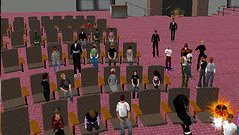
"Throughout the day, we have gotten fleeting glimpses of a replica of Beyond Broadcast — a virtual Ames Courtroom filled with virtual people. This replica conference is taking place in Second Life; a world where every character is controlled by a real person. All objects, buildings, trees, cars and light poles are also created by users.

John Lester, working for the creators of Second Life, Linden Lab, explained the founding principle behind Second Life. John says, “We [at Linden] don’t want to make content, we want to give people tools to make their dreams and shape their world.”

Every resident, Linden’s term for user, has a powerful 3d modeling kit and scripting language, which enables them to build their fantasy. Lester further describes Second Life as a, “Waking dream environment — not completely surreal or mundane, but smack dab in the middle.”

He illustrates this point with a slide of a concert taking place inside Second Life. The musicians are streaming their live (real world) music into a virtual club; the band member’s avatars play their instruments to a virtual crowd. John points out that there is something cohesive about a bunch of people hanging out in a club listening to music, but, he says, you realize something is up when a member of the crowd seamlessly hovers into the air.

Second Life is set apart from most online games and simulations, in that residents retain intellectual property rights to all their virtual creations. Some residents release their creations as open source, while others retain their rights and make money off their work. Residents earn L$ (Linden dollars), which can be converted to $US on Second Life’s currency exchange. The exchange works just like a real market, where residents post offers to buy and sell money. Residents can even resell their Second Life creations back into the real world.

The most entertaining portion of John’s presentation unfolded behind him, on the projector screen, as he spoke; it was the virtual conference watching the real conference talk about the virtual conference. More than 25 avatars were chatting, watching, sitting, standing and floating in the virtual version of Ames. "

Labels: , ,

Friday, May 12, 2006

Daily Wireless: Best of Friday

If you like the stories I pull here and you have a bent for even more techie type information, you really need to be reading Daily Wireless.

Great posts today:
"Om Malik says Clearwire has filed to go public and is looking to raise as much as $400 million. Merrill Lynch, Morgan Stanley, J.P. Morgan Securities, Bear Sterns, and Wachovia Capital Markets are the underwriters. Clearwire has raised nearly $360 million so far from backers that include McCaw, Intel Corp., and Bell Canada."
And the winner is!!!"USA Today reports that the National Spy Agency has collected billions of records of domestic telephone calls. AT&T, Verizon and BellSouth have turned over records of calls. It is the NSA's goal "to create a database of every call ever made", reports the paper."

Labels: ,

Thursday, May 11, 2006

AT&T and MobiTV

From Daily Wireless:

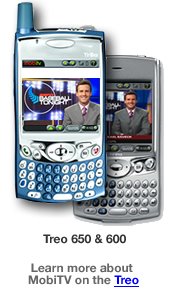
"AT&T and MobiTV today announced they will deliver mobile television content over AT&T's nationwide Wi-Fi network. The service will enable AT&T customers to view live television while connected to one of AT&T's/SBC's Wi-Fi hot spots.

The MobiTV service includes 15 channels spanning national news, sports, entertainment and full-length music videos. The service will be available this month at nearly 7,000 AT&T owned and operated Wi-Fi hot spots, which includes airports, coffee shops and book stores, with plans to expand to additional locations.

Users will have a basic channel line-up available through a monthly $11.99 subscription or for each 24-hour session for $5.99. Additional premium television channels will be offered soon.

"Having topped 1,000,000 subscribers and growing faster than ever, we've proved MobiTV's technology, business model, and profitability on mobile networks across international markets on three continents," said Dr. Phillip Alvelda, chairman and chief executive officer for MobiTV. "Now, in partnership with AT&T, the nation's leading DSL provider, we are proving that the MobiTV service can deliver premium quality content seamlessly across any of the latest broadband networks."

Labels: ,

Unlimited Data on Cell Phones

MocoNews reports on an article behind registration at the WSJ about cellular companies reactions to users of thier "unlimited" data plans.

From MocoNews:

"WSJ has a good story collecting stories about operators asking users to stop using Internet on their mobile phones if the usage becomes high (individual stories have surfaced on various personal blogs before). The unlimited data/internet plans has some operators worried, and they are taking steps to make sure subscribers don’t use them too much.

Verizon Wireless has sent service-cancellation notices to customers it says are using excessive network capacity. Sprint and Cingular Wireless, meanwhile, have moved to charge people for the amount of data bits they wirelessly transfer to their computers each month.

Dick Lynch, Verizon CTO says that the company is developing technology to sense what applications consumers are using so that violations can be detected more precisely (ah, borderline privacy violation, they mean).

But some technology consultants and analysts say wireless companies will need to make their services more similar to those offered by phone and cable companies if they want more consumers to adopt them (read unlimited)."

Labels: , ,

Monday, May 08, 2006

Welcome to the Sim Dollhouse

Its funny how memes run in herds. From the New York Times, Sims are becoming the new dolls children play with.

From the article:

"As far as we know, children have always played with dolls of one sort or another to act out variations on their own lives, or lives they observe or imagine. Today, a vast and growing number of kids are doing the same thing — but with a very new tool. Instead of dolls, they are using video games. And perhaps most of all, they're using The Sims.

"I like Sims more than other games, and Sims is way more fun than TV because TV gets so boring — you just stare at a screen and watch and watch and watch," Francesca said. "But in The Sims you make your own characters and give them a personality and give them stuff and build their houses and make them live."

Richard said firmly: "Making characters is a lot more fun than watching TV. And with commercials you have to wait. I don't like to wait."

"Initially I was a little concerned because it is rated T for Teen and Francesca said she had tried it at a friend's house and I was concerned that she had done that without checking with me first," she said, "But then I looked into it and now I don't mind them playing this game at all. Actually, it seems to have some value for them. And I'll tell you, she used to really be into dolls, like Barbies and the Bratz dolls; once The Sims came along the dolls were done. And I mean done."

Labels: ,

Thursday, May 04, 2006

OnHollywood 2006: Ted Cohen, Jennifer Feikin and Jeremy Allaire

OnHollywood 2006 is going on this week.

From the website:

"OnHollywood is where cutting edge technology from teh backstreets of Silicon Valley meets Hollywood's digital media revolution."

Flickr photos here.

Ted Cohen:

"The audience is taking over the programming," according to Ted Cohen,senior vice president of Digital Development and Distribution at EMI Music. "A few years ago we looked at litigating it, now we are looking at how to monetize it."

"You can't set up too many rules right now….if you don't let them play they will play anyway, so we have to figure out how to monetize it," he said.

Jennifer Feikin:

"Much of what is on the Internet is now a novelty, but it has an additional way to express and communication that wasn't there before. It's also a good way to find content, but it needs to be good content. It's not just about the distribution. More content is being created, but the best content is what will be watched," Feikin said.

"Come back in a year…the whole revolution is only eight months old. We really don't know what will work. Today it's short form comedy and video content, very PC-based.

Jeremy Allaire:

"How to get syndication and aggregation is not figured out," he said.

Labels:

Cingular Brand Worth 4 Billion

When AT&T cuts the Cingular brand it will loose the 4 billion dollars that was spent building one of the most successful cellular brands.

From RCRNews:

"Not only is AT&T—in the throes of acquiring Cingular owner BellSouth Corp.—planning to ditch the Cingular name and ubiquitous, sprightly orange jack, but it will replace it with its own stodgy moniker, renaming the division AT&T Wireless. Such a move could conjure up images of the rotary dial and cause so much confusion that experts estimate it may take another $2 billion in marketing expenses to explain the changes to consumers.

AT&T argues that the $4 billion spent building Cingular—it will lay out around $1 billion this year alone—won’t be wasted, because, in the words of spokesman Michael Coe, it has “created a brand that has led to a customer base which is the largest in the U.S.” The company also claims that the single moniker for all AT&T services will “eliminate customer confusion and make a much more elegant solution.”

“To give up Cingular is a mistake,” especially in favor of AT&T, “my father’s brand of telephony,” said Jonathan Asher, president, Dragon Rouge USA, a branding and design consultancy.

Karl Barnhart, managing director, CoreBrand, New York, a former AT&T agency, agreed that changing the Cingular name “doesn't make sense.” Cingular’s brand is “relevant for the younger audience; it’s a fun, hip, interesting, dynamic—everything you don’t think about AT&T.”

The head of one wireless company joked that AT&T is spending a lot of money for virtually the same logo and a lot of lower case letters."

Labels:

Wednesday, May 03, 2006

TV 2.0

There is a lot of movement in the TV world these days. ABC is goldcasting some of its best shows, FOX is trying to figure out ways to link MySpace with traditional television, and affiliates are watching to see what scrapes hit the floor.

Stephen Warley at Lost Remote makes a comment that rings true to me:

"Yes, NBC and Fox are cutting deals to share online revenue with their affiliates, but in the digital age, I just don’t see the long-term value of the network/affiliate relationship. People watch “programs,” not “networks” or “stations”. If I were a station GM, I’d focus on producing local programs and building deeper websites full of unique local information. That’s where the real money is going to be for local affiliates over the long term."

Labels: , ,